The following sessions at Microsoft Ignite 2020 are US Government specific, focusing on GCC, GCC High, and DoD tenants in Microsoft 365 and were quite interesting:

  • Increase security, reduce risk, and maximize government resources
    Steve Faehl US Security CTO; Dean Iacovelli, SLG Director; Bryan Hunt, SLG Director
    imageMicrosoft 365 Government session on building your security strategy, endpoints, identity. Risk reduction through addressing insider threats; maximize resources with one secure productive platform. Business impact conversation and what are the outcomes for the BDMs:
        • How to automate your processes, security operations modernization
        • How to engage, when, where, and with whom
        • Security needs with remote work, securing endpoints in a new way
  • Streamline your mission with Microsoft 365 Compliance
    Matthew Littleton, Microsoft 365 Advanced Compliance Specialist
    imageProtect citizen data and build trust by including data protection and data governance in strategy planning with your CISOs. What actions can you take:
      • know your data and what needs to be protected
      • use unified labeling
      • build incident response plan with your security team leveraging advanced audit and eDiscovery
  • Improving the Customer Experience for Government Services
    Bobby Chang, Technology Specialist; Brian Duncan, Senior Solutions Architect
    imageIn a world of instant access to almost anything, customers have high expectations for service. Service providers today offer mobile-friendly apps, live chat, self-service, and 24-7 access as a matter of course. The public expects no less of government services. Microsoft is uniquely positioned to support government customers, as the only company offering an integrated government cloud suite comprised of productivity tools (Office 365), business application tools (Power Platform and Dynamics 365), and cloud development extensions (Azure).
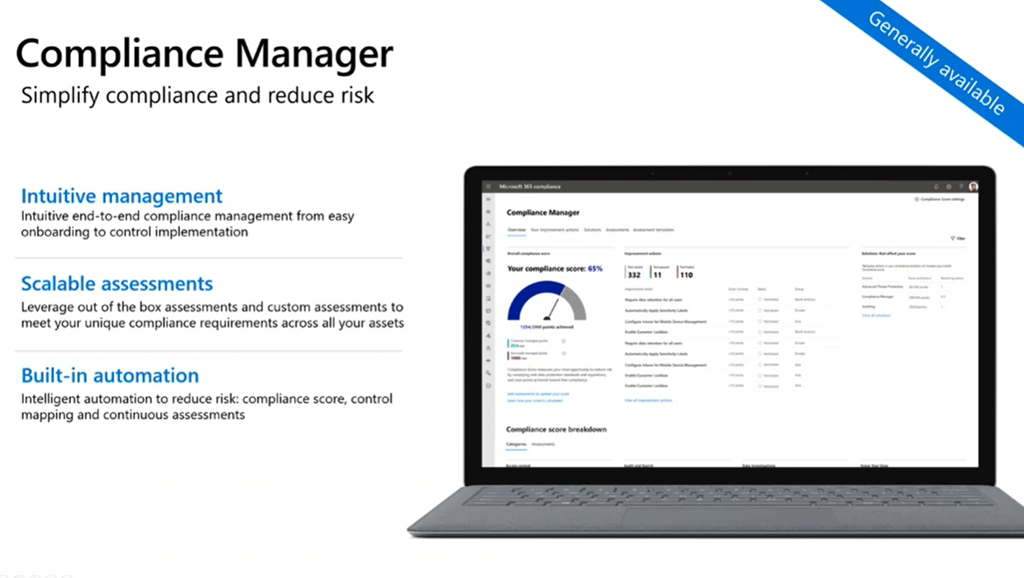
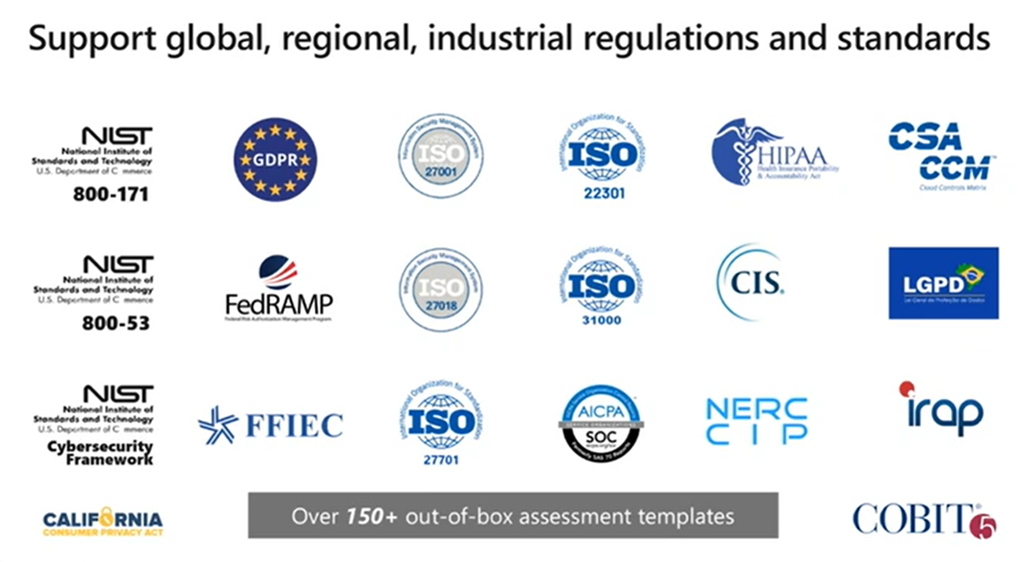
imageIn addition to the release of the NEW Compliance Manager for Microsoft 365, Microsoft quietly released a massive collection of “compliance assessment templates” for Microsoft 365 that will evaluate your environment for compliance against any one of a 150+ regulations.

Access to Compliance Manager is controlled by setting user permissions and assigning roles. For more information, see Documentation here.

COMPLIANCE TEMPLATE LICENSING
Customers with Office 365 E1/A1/E3/A3 and Microsoft 365 E3/A3 licenses will be able to access the following assessment:

  • Data Protection Baseline

Customers with Office 365 E5/A5 and Microsoft 365 E5/A5 licenses will be able to access the following out-of-the-box assessments:

  • Data Protection Baseline
  • GDPR
  • NIST 800-53
  • ISO 22701

Premium assessments will be available for purchase to Office 365 E5/A5 and Microsoft 365 E5/A5 customers.

COMPLIANCE MANAGER WEBINAR
The Information Protection team recently did a webinar going over the Compliance Manager interface.
Click here to view the webinar recording.

    RESOURCES:

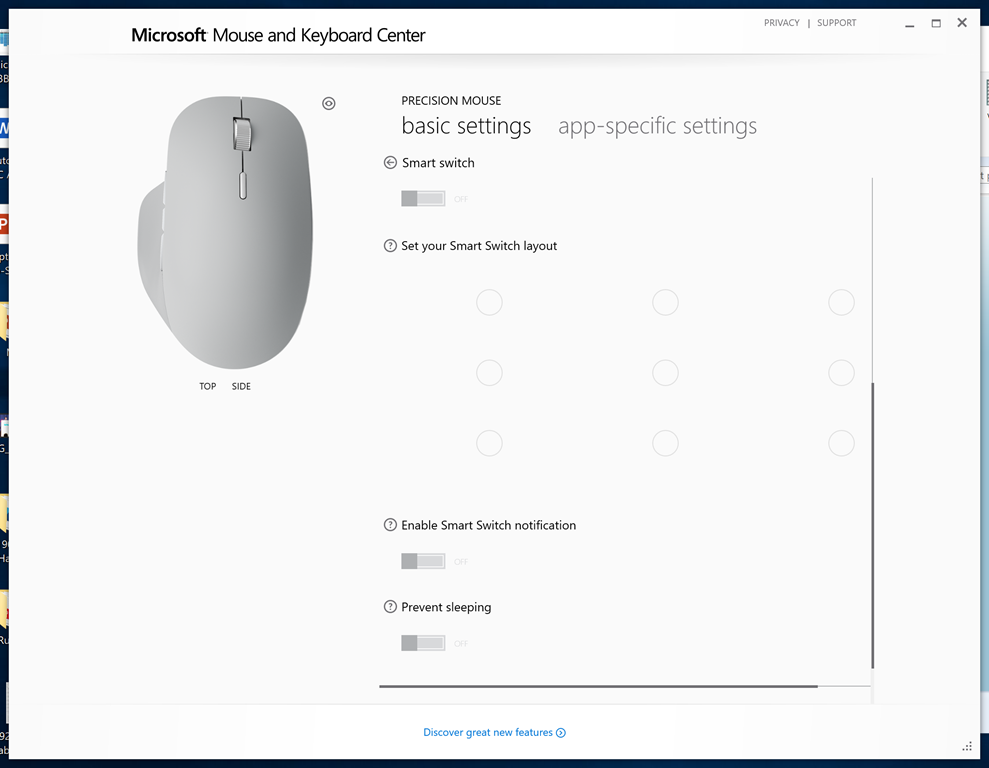
    imageImagine being able to seamlessly control 9  computers running Windows 10 at the same time from a single mouse & keyboard – without extra hardware or without 3rd party software.

    Introducing the new release of the “Microsoft Mouse & Keyboard Center”, the control software for Microsoft Mice & Keyboards. (v13.221.137)

    Some of you may know solutions like Mouse without Borders, Synergy, SpaceDesk and other tools that allow you to control multiple computers from a single mouse & keyboard.  Personally, I’ve used Multiplicity for more than a decade.

    Now, much of that functionality is available for free in the new release of “Microsoft Mouse & Keyboard Center”.

    imageMKC allows users of Microsoft Mice to seamlessly move the mouse pointer from one computer to another simply by moving the pointer past the edge of one PC & continuing on the next.  The software knows which computer you want to control by allowing you to layout how your computers are organized in a 3×3 grid.

    If you own multiple computers on your desk & you have a Microsoft mouse, give this new software release a try.

    Posted by: kurtsh | September 30, 2020

    TRAINING: Microsoft Ignite 2020 Keynote Sessions

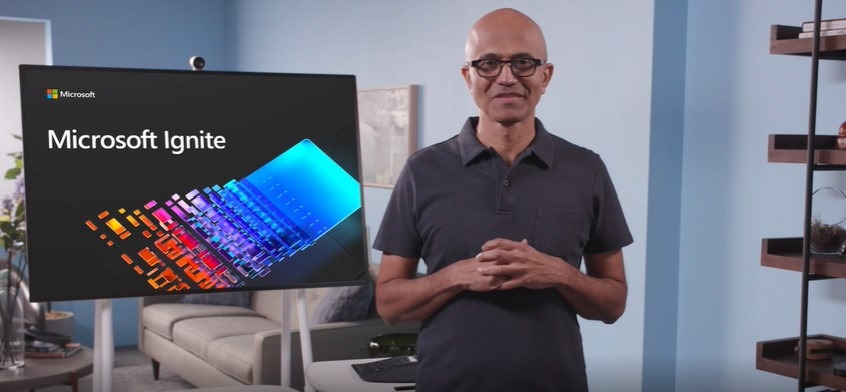
    Satya at IgniteIf you missed Microsoft Ignite 2020, and would like to see the keynotes, here’s a list of all the links to the recordings of everyone from our CEO, Satya Nadella, to Jason Zander, Exec VP of Azure, to Jarad Spataro, Corp VP of Microsoft 365.

    Most are 30-60min long.

    • KEY01 – “Building Digital Resilience”
      Satya Nadella, CEO, Microsoft
    • KEY02 – “Invent with Purpose on Azure” 
      Julia White, Corporate Vice President, Microsoft Azure
    • KEY03 – “Microsoft Power Platform: Fill the App Gap and Supercharge Organizational Agility”
      James Phillips, President, Business Applications Group
    • KEY04 – “The Future of Work”
      Jared Spataro, Corporate Vice President, Microsoft 365
    • KEY05 – “Microsoft Dynamics 365: Reimagine How You Can Meet The Needs of Tomorrow”
      Alysa Taylor, Corporate Vice President,  Business Applications
    • KEY06 – “Achieve resilience with Security, Compliance, and Identity
      Vasu Jakkal, Corporate Vice President, Security, Compliance, and Identity
    • KEY07 – “Are we there yet? App Development in Azure”
      Scott Hanselman, Partner Program Manager
    • KEY08 – “Envisioning the Future: How Microsoft Approaches Innovation”
      Mitra Azizirad, Corporate Vice President, Artificial Intelligence
    • KEY09 – “Panos and Brad Unplugged: A Conversation About New Hybrid Workstyles with Windows and Microsoft 365”
      Panos Panay, Chief Product Officer
      Brad Anderson, Corporate Vice President, Microsoft 365 (Deployment & Management)
    • KEY10 – Microsoft Azure Unplugged with Jason and Billy”
      Billy Anders, Corporate Vice President, Azure CxP – Engineering & Customer Experience
      Jason Zander, Executive Vice President, Microsoft Azure
    Posted by: kurtsh | September 27, 2020

    TRAINING: Tips for “AI-900 Azure AI Fundamentals”

    imageI recently passed the AI-900 “Microsoft AI Fundamentals” certification and got a lot of people asking me about it.

    I’ve typed up the following information for anyone looking to get the AI-900 cert under their belt because I think they might be gotchas for some. These are the things I personally got tested on.
    (Please note that the exam content is changing Oct 20th so take the exam soon if you plan to use the internal materials to prep)

    • Machine Learning
      There is an expectation that you have directly used – or at least witnessed the proper usage of https://ml.azure.com – “Azure Machine Learning Designer” & “Automated ML”.
          • Watch how to build a pipeline, how to prep your dataset, where to apply algorithms, and when to split data.
            Ex: “Where in the pipeline do you split data?” “Why do you do that?” “Where do you apply ML algorithms?”
          • Pay attention to the selection of Automated ML “task types” & what algorithms you can block like ElasticNet, ExtremeRandomTrees, XGBootRegressor, etc.
            Ex: “What are examples of 2 algorithms could be blocked in your Automated ML model training?”
          • Know the difference between “Feature Selection” vs “Feature Engineering” in Automated ML
            Ex: “What are examples of Feature Selection?” “Examples of Feature Engineering?” “When do you use them in the configuring your Automated ML run?”
    • Cognitive Services
      There is an expectation that you can determine when to apply Azure Machine Learning, Azure Cognitive Services, Azure Computer Vision, & Azure Custom Vision – and what is required to implement them in Azure & how to use them in applications.
        • Pay attention to the diversity of services Cognitive Services provides, Computer Vision provides and what Custom Vision offers beyond custom data modeling.
          Ex: “Does Computer Vision offer optical character recognition?” “Do you need to provide custom data for Custom Vision?“Why not use Azure Cognitive Services over Computer Vision?
        • Pay attention to the differences between Text Analytics, Language Understanding Intelligent Service, Bot Service, QnA Maker.
          Ex: “Do you need to provide LUIS with custom models?” “Can you use LUIS with Bot Service?” “Does QnA Maker refresh it’s model when you change your QnA data?”
        • Understand what the I/O parameters of a creating & using a Cognitive Services resource.
          Ex: “What is required to stand up a Cognitive Services resource in Azure?” “Name two properties that a Cognitive Resource produces for you to use it in your application?”

    Posted by: kurtsh | September 25, 2020

    TRAINING: Azure SQL Bootcamp (On-demand)

    imageWe recently published an amazing series of videos that go over Azure SQL soup to nuts from installation to security to high availability to performance to everything in between.

    Here’s the chapters:

    • Introduction to Azure SQL Deployment and Configuration | Azure SQL Bootcamp (Session 1)
      Starting with a brief history of why and how we built Azure SQL, you’ll then learn about the various deployment options and service tiers, including what to use when. This includes Azure SQL Database, Azure SQL managed instance and SQL Server in Azure VMs. Understanding what Infrastructure as a Service (IaaS) and Platform as a Service (PaaS) encompasses and how it compares to the SQL Server “box” will help level-set what you get (and don’t get) when you move to the cloud.
      We’ll then get in to covering deployment, configuration, and other getting started related tasks for Azure SQL. You’ll learn how you should plan for deployment, deploy, and verify your deployment, and how it compares to SQL Server. Then, you’ll learn how deploying and configuring databases compares, plus some insights on loading data.

    • Secure Azure SQL and Deliver Consistent Performance | Azure SQL Bootcamp (Session 2)
      Ensuring security and compliance of your data is always a top priority. You’ll learn how to use Azure SQL to secure your data, how to configure logins and users, how to use tools and techniques for monitoring security, how to ensure your data meets industry and regulatory compliance standards, and how to leverage the extra benefits and intelligence that is only available in Azure. We’ll also cover some of the networking considerations for securing SQL.
      You’ve also been responsible for getting your SQL fast, keeping it fast, and making it fast again when something is wrong. We’ll show you how to leverage your existing performance skills, processes, and tools and apply them to Azure SQL, including taking advantage of the intelligence in Azure to keep your database tuned.

    • Deploy Highly Available SQL Solutions & Solve Real-world Scenarios | Azure SQL Bootcamp (Session 3)
      Depending on the SLA your business requires, Azure SQL has the options you need including built-in capabilities. You will learn how to translate your knowledge of backup/restore, Always on failover cluster instances, and Always On availability groups with the options for business continuity in Azure SQL. In the final activity, we’ll validate your Azure SQL expertise with a challenging problem-solution exercise. We’ll then broaden your horizons to the many other opportunities and resources for personal and corporate growth that Azure offer.

    Access the training list here:

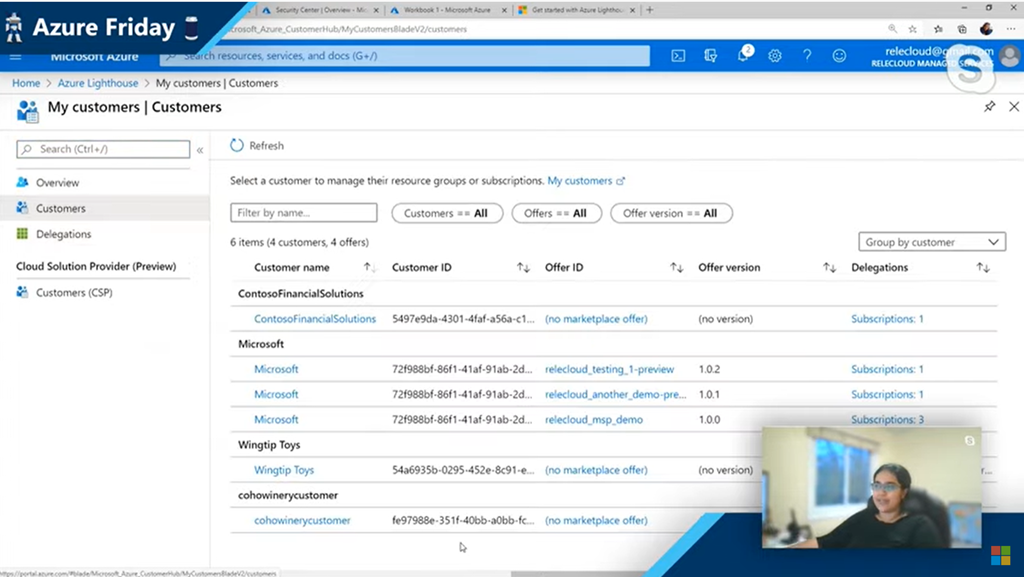
    imageArchana Balakrishnan joins Scott Hanselman to show how Azure Lighthouse can manage hundreds of customers, thousands of subscriptions, and millions of resources from a unified control plane.

    Azure Lighthouse helps deliver managed services with comprehensive and robust management tooling available in Azure.

    Benefits include:

    • SINGLE SIGN ON – With a single ID, manage all your customers/departments & their subscriptions – instead of logging into each Azure environment with a different identity.
    • ONE CONSOLE – View all your managed customers from a single pane of glass
    • FLEXIBLE ROLES – Empower departments to select what rights/permissions to grant your organization (an individual or a group)_ as a manager of part/all of their Azure environment.
    • ON-PREM MANAGEMENT – Manage on-premises servers (through an agent installed on them)
    • ENFORCE POLICIES – Establish and assign policies to ensure adherence to rules & identify systems that are not compliant
    • MONITOR COMPLIANCE – Aggregate & view policy compliance, health issues & severity across all subscriptions
    • DEPLOY WORKBOOKS – Apply administrative workbooks – like Backup – to identify who’s being backed up, which subscriptions have backups have failed, etc.

    Video table of contents:

    Learning more about Azure Lighthouse:

    Watch the full overview & video demonstration here:

    Language Understanding (LUIS) authoring authentication changed from an email account to an Azure resource. Although it’s not currently required, switching to an Azure resource will be enforced in the future.

    And that future is Nov 2nd, 2020.

    If you’re using LUIS today, be aware that you need to switch over your implementation to Azure resource authentication… otherwise your implementation of LUIS will no longer work.

    Read more on what this is and how to migrate here:

    Posted by: kurtsh | September 23, 2020

    INFO: “Book of News” for Microsoft Ignite 2020

    Wanna make sure you’re plugged in to all the big news being released at Ignite?

    We have a single site called the “Book of News” for Microsoft Ignite 2020 that lists all our major announcements:

    imageThe Microsoft Ignite 2020 Book of News is your guide to the key news items that we are announcing at Ignite. To make the Book of News more interactive, we’ve created a live site that we hope you will find engaging and easy to navigate. Instead of scrolling through pages of content, you now have the option to select the items you are interested in from the table of contents. We hope the new changes will help you get all the information, executive insight and context you need.

    This thing is massive.  Be sure to click on the “hamburger menu” (three horizontal lines) in the upper right hand corner to reveal the “Tablet of Contents” – otherwise you’ll be scrolling for ever.  Here’s a glimpse of what’s covered:

      • 1. AZURE

      • Azure and Application Development news with Julia White and Frank Shaw

      • 1.1. Azure AI

      • 1.2 Azure Data

      • 1.3 Azure Datacenters

      • 1.4 Azure Dev and Ecosystem

      • 1.5 Azure Hybrid, Azure Infra, Azure Migrate

      • 1.6 Azure IoT

      • 1.7 Azure MR

      • 1.8 Azure Networking

      • 1.9 Windows Virtual Desktop

      • 2. BUSINESS APPLICATIONS

        • D365 and Power Platform news with Alysa Taylor & Frank Shaw

        • 2.1 Power Platform

        • 2.2 Dynamics 365

        • 4. MICROSOFT 365

          • M365 news with Jared Spataro and Frank Shaw

          • 4.1 Cortana

          • 4.2 Excel

          • 4.3 Insights and wellbeing

          • 4.4 IT Pro

          • 4.5 Outlook

          • 4.6 Project Cortex

          • 4.7 Microsoft Search

          • 4.8 SharePoint and Yammer

          • 4.9 Microsoft Stream

          • 4.10 Microsoft Teams

        Check it out here:

        imageToday, we are thrilled to announce the Public Preview of a built-in cross-tenant mailbox migration service that enables you to move mailboxes between tenants with minimal on-premises infrastructure dependencies (the new service eliminates some but not all on-premises components). The new cross-tenant mailbox migration service eliminates the need to offboard and onboard mailboxes, resulting in a faster and lower-cost migration. This is particularly beneficial for organizations undergoing mergers, acquisitions, divestitures, or splits.

        The new move process includes enhanced security, as well as the ability to scope moves. It uses an Enterprise Application in Azure Active Directory (Azure AD) and Azure Key Vault, allowing tenant admins to manage both authorization and the scoping of mailbox migrations from one tenant to another. Cross-tenant mailbox migrations use an invitation and consent model to establish the Azure AD Enterprise Application used for authentication between tenants.

        Read more at the announcement here::

        « Newer Posts - Older Posts »

        Categories