imageA week ago, we announced “Windows Thin PC”, the next version of “Windows Fundamentals for Legacy PCs”… for volume licensing customers with Software Assurance on Windows Client.

WHAT IS IT?
Windows Thin PC provides a special, scaled down configuration of Windows Embedded 7 for installation on existing older PCs.  The operating system is light and designed to operate on lower end machines while still providing all the traditional manageability of a Windows desktop – including compatibility with:

  • Optional Components at install
    • Internet Explorer 8.0
    • Windows Media Player
  • Local installs of Allowed Microsoft Applications
    • Desktop management agents – like SCCM2007R2
    • Windows Firewall
    • Anti-virus software – like Forefront Endpoint Protection 2010
    • .NET Framework
    • Office Viewers
  • Allowed 3rd party ISV apps
    • Thin client software like Remote Desktop Connection or Citrix Receiver
    • Terminal Emulation products
    • Java Virtual Machines
    • Acrobat Reader
    • etc.

WHAT BENEFITS DOES IT HAVE?
I believe that it’s benefits are identical to that of its predecessor except with a much richer code base being that WinFLP, the previous version of Windows Thin PC, was based on Windows XP Embedded SP3… and of course WinTPC is based on Windows Embedded 7.

  • Minimal Deployment Curve
    • Works with existing admin tools & client utilities
    • Same security & management infrastructure
  • Minimized hardware requirements on CPU/memory/disk
    • Increases performance of client-facing apps
    • Decreases workstation security risks, data loss concerns
  • Optional apps allow org-specific customization
    • Windows terminals… through Remote Desktop/Citrix
      (The client will still require appropriate Terminal Client licensing)
    • Web-based kiosks… through IE 8.0
    • Media kiosk… through Windows Media Player

WHO CAN USE “WINDOWS THIN PC”?
To reiterate – this is ONLY for use by volume licensed customers with Software Assurance on Windows Client.  This is typically a 3 year or more spread payment contract between a volume license customer and Microsoft for the use of the currently released revision of the Window OS. (And any past releases that are supported)

It should be available for download from the Microsoft Connect test site later in the first calendar quarter of 2011.

More about WinTPC is written here:

Posted by: kurtsh | February 19, 2011

TOOL: System Restore Manager 2.0 for Windows 7

imageLee Wittington, one of the guys at the Windows Club, produced a tool that provides frankly better management of the Windows 7 System Restore function than the native Control Panel user interface.

Leveraging existing Windows APIs, the System Restore Manager v2.0 tool provides a graphical way of:

  • Creating Restore Points
  • Deleting individual Restore Points
  • Restoring the system to a Restore Point
  • Writing Restore Points to a different drive
  • Changing the max space used for Restore Points
  • Changing the frequency of restore point snapshots
  • Changing the length of time a restore point is kept

TOOL:  System Restore Manager 2.0
http://www.thewindowsclub.com/downloads/SRM.zip

POST:  Managing Restore Points with System Restore Manager 2.0
http://www.thewindowsclub.com/system-restore-manager-for-windows-released

Posted by: kurtsh | February 19, 2011

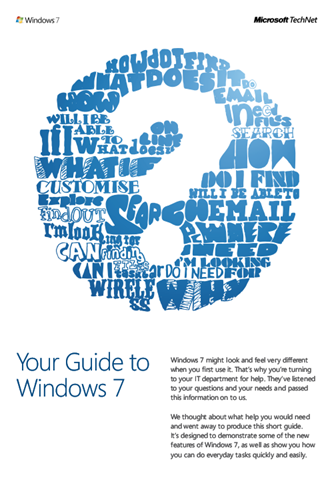
OFFER: Free eBook–“Your Guide to Windows 7”

image

A short 8-page eBook/document’s been released for Windows 7 by the usability group here at Microsoft that goes over some of the fundamental differences between Windows Vista & Windows 7.

Subjects covered in this guide, include:

  • “Where have all my gadgets gone?”
  • “I need to find a file.  How do I search for it now?”
  • “Help!  How do I switch to Projector Mode?”
  • “How can I see everything I’ve got open without clicking each individual window?”
  • “How do I quickly get to the files and apps I use most?”
  • “How can I get help from my IT deparment without them being able to see my screen?”

Go check it out.  After all, it’s free.

imageI don’t need to reiterate what everyone’s already written.  I’m so far behind on blog updates because of illness, it’s disgusting.

Here’s some things I know regarding the timeline:

  • February 9:  RTM
  • February 16: Windows 7 and Windows Server 2008 R2 SP1 will be available to MSDN/TechNet subscribers and Volume Licensing customers.
  • February 22: It will be generally available through Windows Update and the Download Center.

Functional improvements:

  • Windows 7 SP1 includes minor updates, including some made previously available through Windows Update, as well as client-side support for two new virtualization features enabled in Windows Server 2008 R2 SP1.
  • Windows Server 2008 R2 SP1will include:
    • RemoteFX: A platform feature with the ability to virtualize the Graphical Processing Unit (GPU) on the server side and deliver next-generation rich media and 3D user experiences for Virtual Desktop Infrastructure (VDI).
    • Dynamic Memory: A free, built-in feature of Hyper-V that allows customers to increase their virtual machine density, using the resources they already have, without sacrificing performance or scalability.

Key notables about SP1:

  • NO UPGRADES. There’s no upgrade from the beta or RC of Service Pack 1.  You need to uninstall the SP prerelease before installing the final bits.
  • NO IE9. Internet Explorer 9.0 is not in the Service Pack.  Internet Explorer will be released later in the year, separate from Service Pack 1.
  • COMBINED SERVICE PACK:  The service pack is a combined installer for both Windows 7 and Windows Server 2008 R2.

Supporting Docs:

image

We published an eBook for individuals interested in the trend toward cloud computing, why it’s happening and how customers should approach this change in the industry.

  • Cloud Computing Basics
    • Cloud Computing
      • Software as a Service (SaaS)
    • Public Cloud
      • Infrastructure as a Service (IaaS)
      • Platform as a Service (PaaS)
    • Private Cloud
    • Hybrid Approach
  • Is Cloud Computing Right for my Business?
    • Core Issues to Consider
  • Microsoft’s Unique Approach to Cloud Computing
    • Applications/Software as a Service (SaaS)
      • Live Services
      • Online Services
      • Business Productivity Online Services
    • Platform as a Service (PaaS)
    • Private Clouds

[opening paragraph]

An Industry Shift Toward Cloud Computing
Since inception, the IT industry experienced a variety of natural evolution points, most marked with rapid change followed by years of internalization and consumption. According to most observers, the industry is rapidly evolving toward services as a core component of how consumers and business users interact with both software and one another. This is being referred to, in different contexts, as “software as a service,” “cloud computing,” “Web 2.0,” or simply “services,” and it represents a new deployment choice for the industry. The hype is deafening in places, and the key to success is recognizing that “cloud” adoption does not represent an all-or-nothing proposition.

image

We’ve released a new 17 page document entitled “Discover Productivity Without Boundaries – Your guide to what’s new in the Office 2010 suites available through Volume Licensing.”

It provides a very thorough comparison between the 3 most recent releases of Office and demonstrates the improvements between each.

Here’s a summary of the contents:

  • Top New Capabilities (Highlights)
  • Compare Microsoft Office 2010 to Previous Versions
    • Use Office Virtually Anywhere
    • Work Better Together
    • Bring Ideas to Life
    • Gain a Practical Productivity Platform for IT
  • Which Edition is Rights for My Business (Office Standard 2010 vs Office Professional Plus 2010)
  • Differences in Features Between Editions
    • Information Rights Management & Policy Capabilities
    • Contextual Access to Business & Social Networking
    • Integrated Enterprise Content Management
    • Publish Data Insights
    • Unified Instant Messaging, Presence & Voice
    • Managed E-Mail Folders & Retention Policy
    • Integrated Electronic Forms

WHITEPAPER:  Feature Comparison – Office 2003, Office 2007, Office 2010
http://www.microsoft.com/downloads/en/details.aspx?FamilyID=4fbcd1ec-269b-4aa3-9866-315a6d3d1284

Taken from the Global Foundation Services blog:

imageToday, I am pleased to announce that Microsoft’s cloud infrastructure has achieved another milestone in receiving its Federal Information Security Management Act of 2002 (FISMA) Authorization to Operate (ATO).  Meeting the requirements of FISMA is an important security requirement for US Federal agencies. The ATO was issued to Microsoft’s Global Foundation Services organization. It covers Microsoft’s cloud infrastructure that provides a trustworthy foundation for the company’s cloud services, including Exchange Online and SharePoint Online, which are currently in the FISMA certification and accreditation process. 

This ATO represents the government’s reliance on our security processes and covers Microsoft’s General Support System and follows NIST Special Publication 800-53 Revision 3 “Recommended Security Controls for Federal Information Systems and Organizations.”

Read more about the announcement at the source:

imageThe Microsoft Security Development Lifecycle (SDL) team has released a new Quick Security Reference white paper addressing “Exposure of Sensitive Information.”

The Exposure of Sensitive Information paper is intended to help information professionals gain a more thorough understanding of how to identify and address exposure of sensitive information vulnerabilities in software.

This compliments the two previous security quick references published on Security Development Lifecycle to help you better understand and address common attacks that may be affecting your software, Web sites, and users.

  • Cross-Site Scripting
  • SQL Injection

DOWNLOAD:  SDL Quick Security References – “Exposure of Sensitive Information”
http://www.microsoft.com/downloads/en/details.aspx?FamilyID=79042476-951f-48d0-8ebb-89f26cf8979d&displaylang=en

imageQuickStart Intelligence is hosting their 6th Regional Intelligence Technology Conference coming up on March 15, 2011 at the Anaheim Convention Center. 

You might have seen their past conferences on SharePoint and Windows, but the topic of the upcoming conference is all about the Cloud – Cloud Intelligence Technology Conference!

This conferences is designed for the IT Manager, Director, VP, CIO/CTO level person to get a high level overview of what “Cloud” is all about so you can start making high level decisions on how to implement a Cloud strategy in your organization.  The level of presentation at this event is 100-200 level, so you can get a good grasp of what Microsoft’s different offerings are without getting too technical. You will also be able to meet several partners in the local area that can help you plan and implement a cloud strategy.

The presenters at the event are comprised of Microsoft Executives, Microsoft Partners, MVPs and Trainers.  The sessions at the event they will be covering include:

Session 1 –

  • Cloud Overview – Office 365 Overview
  • Preparing for the Cloud – Designing a Cloud Architecture
  • SAAS – CRM Online
  • PAAS – Windows Azure
  • Private Cloud – Hyper-V

Session 2 –

  • Cloud Overview – Platform as a Service
  • Preparing for the Cloud – Cloud Security
  • SAAS – SharePoint 2010 Online
  • PAAS – SQL Azure
  • Private Cloud – Citrix

Session 3 –

  • Cloud Overview – Private Cloud
  • Preparing for the Cloud – When Should You Migrate?
  • SAAS – Exchange 2010 Online
  • PAAS – App-Fabric
  • Private Cloud – Management with System Center

Session 4 –

  • Cloud Overview – Cloud Management
  • Preparing for the Cloud – Migration Strategies
  • SAAS – Lync 2010 Online
  • PAAS – Developer Experience
  • Private Cloud –App-V

For more details on the agenda, please visit the Cloud Intelligence website.

DISCOUNT: 
Use the code MSKURT299 and you’ll get into the event for only $299!

Posted by: kurtsh | February 16, 2011

INFO: The Microsoft Los Angeles Blog

imageMicrosoft has officially launched its Los Angeles Blog.  Looks like I’ve got competition, dammit.
Smile

Microsoft has so much going on in Los Angeles – outside of our regional technology programs for our customers and events – that they’ve started up a blog specifically for the geography.  For example, did you know that:

If you’re interested in our community activities and want to get involved, check out the blog at:

« Newer Posts - Older Posts »

Categories