imageAnyone looking for SharePoint Training specifically around architecting & optimizing ENTERPRISE SEARCH?  The following is available for free in case you haven’t seen this:

SharePoint Server 2010 Enterprise Search IT Professional Training

BLOG: SharePoint 2010 Enterprise Search IT Professional Training
http://blogs.technet.com/b/tothesharepoint/archive/2010/10/25/sharepoint-2010-enterprise-search-it-professional-training.aspx

Posted by: kurtsh | April 8, 2011

RELEASE: Windows Embedded Device Manager 2011

imageTo relatively little fanfare – especially for a product that impacts so many endpoints – Microsoft Windows Embedded Device Manager 2011 was released to manufacturing and available to customers with Embedded devices.

Windows Embedded Device Manager 2011 enables enterprises to deploy, assess and update Windows Embedded devices, providing a single management solution that offers enhanced insight and control over IT infrastructure and systems by extending the capabilities of System Center Configuration Manager 2007.

It specifically provides the following capabilities – among other things:  (I’ve highlighted what each capability specifically means to Windows Embedded thin clients)

  • Write filter handling (Critical to updating the thin client’s capabilities)
  • Asset inventorying for device serial numbers, etc. (Important for tracking devices, the software revision they have, & their locations)
  • End-to-end thin client provisioning, firmware tracking/inventorying, automated firmware upgrades.  (Mitigate security issues, upgrade thin client software images, etc.)

This is all above and beyond the thin client management capabilities of SCCM today. (WEMD requires SCCM2007 R2 or R3) We are working closely with Hewlett Packard, Dell, and other thin client/embedded device manufacturers on this product to ensure that integration modules are designed specifically to enable it to manage new thin clients at the product’s launch later this year. 

It will manage – AMONG OTHER THINGS:

  • Windows XP Embedded based thin clients
  • Windows Embedded Standard 2009 thin clients
  • Windows Embedded Standard 7 thin clients

If you have embedded devices like Thin Clients, ATMs, PoS systems, Digital Signage, kiosks, etc, you’ll definitely want to take a look at this exciting new technology for System Center Configuration Manager.

clip_image002New whitepaper that goes over the business level benefits of Windows 7:

Understanding the Benefits of Upgrading to Windows 7

The phone rings at 1:00 A.M., waking an IT professional with a call from the company’s key salesperson who is on the road in Asia. She needs access to confidential application data stored on the server back at headquarters. It’s an issue every enterprise faces—how can people be more connected from the road, without sacrificing the needed level of security?

How many times has this happened to you? What else keeps you up at night? Businesses need technology that helps people work better, but IT departments must balance end user flexibility with

tighter management of the infrastructure, data, and applications. This challenge is complicated by several additional forces competing for your time, attention, and resources: managing costs, planning for contingencies, and ensuring compliance with evolving industry and regulatory requirements. Exactly how well companies handle these forces in the context of their unique computing needs ultimately defines their efficiency, user productivity, and overall effectiveness.

Meeting both IT and end user needs in today’s business environment can be challenging. The Windows® Optimized Desktop relieves the common tension between end users and IT by providing the mobility and flexibility end users want while preserving the security and control that IT professionals need. The Windows Optimized Desktop—which incorporates Windows 7 Enterprise, Windows Server 2008 R2, System Center, and the Microsoft Desktop Optimization Pack (MDOP)—helps organizations transform their desktop infrastructure from a cost center to a business enabler by helping IT make people productive anywhere, manage risks through enhanced security and control, and reduce costs by streamlining PC management. The investments in Windows 7 Enterprise have been shaped by the evolving needs of end users and IT professionals in the enterprise.

This paper explores the questions organizations should consider as they plan for desktop infrastructure that can help them better address client computing challenges. First, it takes a closer look at the issues many enterprise organizations face today, with questions in the first four sections to guide you in a desktop capability assessment for your own organization. Then, later in the paper, you’ll learn how Windows 7 Enterprise can help address the challenges you face.

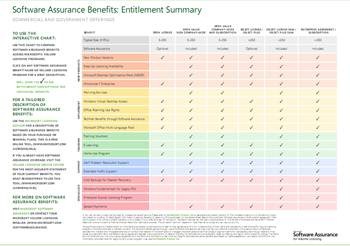
clip_image002INFO:  Microsoft Software Assurance "Interactive Benefits" Chart

A really cool document to help educate yourself about the different components of Software Assurance Benefits that are available.  It’s an actual interactive chart (PDF) that allows a person to click/hover over a given benefit and have its definition just appear on the screen.

It’s externally downloadable here:

There’s also a companion Customer QuickStart Guide:

imageI repeat:  We are making the Microsoft iSCSI Software Target available AS A FREE DOWNLOAD.

What does this mean? It means you can install the Microsoft iSCSI software target on a Windows Server 2008 R2 system and use it as shared storage for Hyper-V Live Migration. Interested? Here are a few key pointers. The full announcement about the release of the Microsoft iSCSI Software Target from Jose Barreto.

For those wondering, Microsoft iSCSI Software Target was technology we acquired from StringBean Software back in 2006, and was previously only available for production use by OEM providers of Windows Storage Server 2008 appliances.  Individuals could only otherwise get it via MSDN/Technet subscriptions for testing purposes only.  Now, with its release to customers of Windows Server 2008 R2, anyone can set up iSCSI solutions at no cost – especially for folks setting up labs or environments that don’t have their own NAS or SAN solutions, or folks that are interested in configuring low cost disk-to-disk backup solutions.

Folks…we just made it possible for anyone to set up their own NAS solution with just a Windows Server 2008 R2 installation & Gigabit Ethernet adapters!

imageJust caught wind of this… limited space since it’s a virtual lab so sign up if you’re interested!

——————

Join AppSense, Microsoft and Citrix for A Day of Virtual Desktop Labs

April 27, 2011 at the Microsoft Technology Center in Irvine 
April 29, 2011 at the Microsoft office in Downtown Los Angeles

Are you evaluating or deploying virtual desktops in your environment?
AppSense, Citrix and Microsoft are pleased to be delivering A Day of Virtual Desktop Labs and we hope you can join us! It is being held at the Microsoft Technology Center in Irvine on April 27th 2011 and also on April 29th at the Microsoft office in Downtown LA.

This seminar offers the opportunity to spend a day with Microsoft, Citrix, and AppSense testing the latest technology. This day provides hands-on, technical training sessions to implement and deploy AppSense Management Suite, Citrix XenDesktop 5, and Microsoft App-V. During this lab session you will have access to a personal workstation environment and learn, step-by-step, how to install a virtual desktop from a best practices perspective.

  • Click here to register for April 27th
  • Click here to register for April 29th
Posted by: kurtsh | April 1, 2011

BETA: "Windows Thin PC" Community Technology Preview

The Windows Thin PC Community Technology Preview (Beta) is now live for folks to try. Here’s the announcement from the Windows Team Blog:

Thin is “In” Especially When it Comes to Getting More Life out of Computers that You Already Own

Last month, we blogged about an upcoming community technology preview (CTP) for Windows Thin PC, which is a locked down version of Windows 7 designed to help repurpose existing PCs as thin clients extending the life of existing hardware. As a follow-on to the CTP post I also discussed ways to think about thin clients in your environment when using server based desktops and applications. Throughout MMS, I heard many customers express interest in this technology and ask about the timing of the Windows Thin PC CTP.

As planned, we are happy to announce that the Windows Thin PC public CTP is now available! Although the final release of Windows Thin PC will be provided as a benefit for Software Assurance customers, we heard feedback that you wanted us to broaden the access of the CTP, so we’re pleased to announce that this CTP is public and therefore available for all customers to evaluate. UPDATE: Please note -To download the public CTP of Windows Thin PC you must first register on the Microsoft Connect site homepage.

For those who have been following our updates, this CTP version includes some new features which we had not previously talked about:

1) RemoteFX support for a richer, higher fidelity hosted desktop experience.

2) Support for System Center Configuration Manager, to help deploy and manage WinTPC images.

3) Write filter support helps prevent user and application writes to disk, thereby improving security at the end point

More information and resources can be found on the CTP download site, and as always we encourage you to install the preview and send us feedback via the tools on the Microsoft Connect site.

DOWNLOAD: Windows Thin PC Community Technology Preview
https://connect.microsoft.com/windowsembedded/program6810

Prepare for an automatic Windows Update that will block the rogue SSL certificates that were issued by Comodo.  In case you hadn’t heard, Comodo accidentally issued certificates that illicitly represent:

  • login.live.com
  • mail.google.com
  • http://www.google.com
  • login.yahoo.com (3 certificates)
  • login.skype.com
  • addons.mozilla.org
  • “Global Trustee”

Yeah.  Not good.  Users could hit a web site claiming to be one of the above and the certificate would verify their authenticity as legitimate.  This would enable them to capture those users authentication credentials and other information they enter in.

More details are posted here:

imageThe Microsoft Security Update Guide is a valuable source of in-depth information and tools that can help you protect your IT infrastructure while creating a safer, more secure computing and Internet environment. We developed this guide to help IT professionals better understand and maximize Microsoft security update release information, processes, communications, and tools.

What’s included? Let us show you.

  • Get to know the security update release process.
    Do you want to get a better understanding of the Microsoft Security Update release process? We’ll give you a complete rundown of the guidance and resources that accompany updates. We’ll also provide a reference guide you can use to develop a customer risk-management framework.
  • See how to mitigate security risks
    When faced with a vulnerability, how do you mitigate the risk? We’ll point you in the right direction.
  • Understand how quickly you need to apply updates
    How quickly should you deploy updates when faced with a security risk? We recommend that you have at least two timelines for handling security updates based on your risk assessment.
  • Assess your update
    How well did your update go? What happens after you’ve deployed an update? What can you do to better manage updates in the future? We’ll show you methods to assess these questions.
  • Get ongoing security
    What can you do to improve security, even when there aren’t any security updates available? How do you stay alert to threats in today’s evolving IT landscape? In this section, we’ll go over how you can get better oversight into your IT systems and how secure they are.

WHITEPAPER:  Microsoft Security Update Guide, Second Edition
http://www.microsoft.com/security/msrc/whatwedo/securityguide.aspx

IDC Research officially confirms Ovum’s original study that Windows Phone 7 is to be the #2 mobile OS in 2015 with 20.9%, behind Android at 45.4% with iOS in 3rd with 15.3%.

IDC Forecasts Worldwide Smartphone Market to Grow by Nearly 50% in 2011

29 Mar 2011

Nokia’s recent announcement to shift from Symbian to Windows Phone will have significant implications for the smartphone market going forward. "Up until the launch of Windows Phone 7 last year, Microsoft has steadily lost market share while other operating systems have brought forth new and appealing experiences," added Llamas. "The new alliance brings together Nokia’s hardware capabilities and Windows Phone’s differentiated platform. We expect the first devices to launch in 2012. By 2015, IDC expects Windows Phone to be number 2 operating system worldwide behind Android."

Worldwide Smartphone Operating System 2011 and 2015 Market Share and 2011-2015 CAGR (listed alphabetically)

Operating System

2011 Market Share

2015 Market Share

2011-2015 CAGR

Android

39.5%

45.4%

23.8%

BlackBerry

14.9%

13.7%

17.1%

iOS

15.7%

15.3%

18.8%

Symbian

20.9%

0.2%

-65.0%

Windows Phone 7/Windows Mobile

5.5%

20.9%

67.1%

Others

3.5%

4.6%

28.0%

Total

100.0%

100.0%

19.6%

Source: IDC Worldwide Quarterly Mobile Phone Tracker, March 29, 2011

Read the full report here:

« Newer Posts - Older Posts »

Categories