Posted by: kurtsh | September 11, 2009

DOWNLOAD: SQL Server 2008 System Views Map

image I didn’t know we’d posted this but better late than never I suppose.

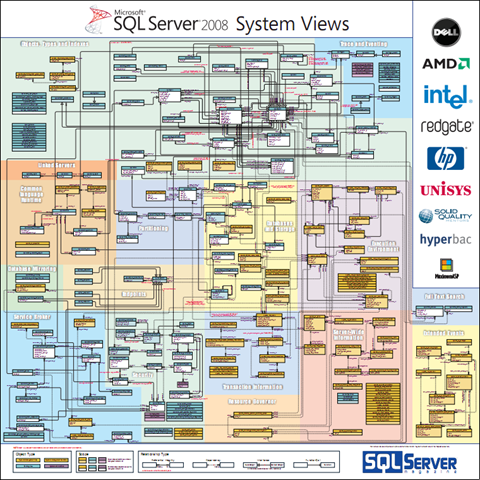
In early January, we posted the soft copy of our SQL Server 2008 System Views map poster.  This map shows the key system views included in SQL Server 2008, and the relationships between them.

The map is similar to the Microsoft SQL Server 2005 version and includes updates for the new and updated the Microsoft SQL Server 2008 features such as resource governor, extended events, full-text search, and others.

Want a Hard Copy?
Yup.  I have hard copies of this poster.  If you’re a customer of mine and you’re interested in having a glossy copy of the poster, ping me with your name, mailing address (no PO Boxes please), and phone number (required for FedEx) and I’ll drop one in the mail for you.

DOWNLOAD:  SQL Server 2008 System Views Poster
http://www.microsoft.com/downloads/details.aspx?familyid=531C53E7-8A2A-4375-8F2F-5D799AA67B5C&displaylang=en

Digg This

image

We recently released the Group Policy ADMX documentation for the policies configurable for Windows 7/Windows Server 2008 R2.

This spreadsheet lists the policy settings for computer and user configurations included in the Administrative template files (.admx/.adml) delivered with Windows Server 2008 R2 and Windows 7. The policy settings included in this spreadsheet cover Windows 7, Windows Server 2008 R2, Windows Server 2008, Windows Vista with SP1, Windows Server 2003 with SP2 and earlier service packs, Windows XP Professional with SP2 and earlier service packs, and Windows 2000 with SP4 and earlier service packs.

What are the major changes?
The following changes are available in Windows Server® 2008 R2 and in Windows® 7 with Remote Server Administration Tools (RSAT):

Are there any special considerations?
You can manage local and domain Group Policy by using domain-based versions of Windows Server 2008 R2. Although the Group Policy Management Console (GPMC) is distributed with Windows Server 2008 R2, you must install Group Policy Management as a feature through Server Manager.

You can also manage local and domain Group Policy by using Windows 7. For managing local Group Policy, the Group Policy Object Editor has been replaced by the Local Group Policy Editor. To manage domain Group Policy, you must first install the GPMC. The GPMC is included with RSAT, which is available for download:

RSAT enables IT administrators to remotely manage roles and features in Windows Server 2008 R2 from a computer that is running Windows 7. RSAT includes support for the remote management of computers that are running either a Server Core installation or the full installation option of Windows Server 2008 R2. The functionality RSAT provides is similar to Windows Server 2003 Administration Tools Pack.

Installing RSAT does not automatically install the GPMC. To install the GPMC after you install RSAT, click Programs in Control Panel, click Turn Windows features on or off, expand Remote Server Administration Tools, expand Feature Administration Tools, and select the Feature Administration Tools and Group Policy Management Tools check boxes.

——————-

DOWNLOAD:  Group Policy Settings Reference for Windows Server 2008 R2 and Windows 7
http://www.microsoft.com/downloads/details.aspx?FamilyID=18c90c80-8b0a-4906-a4f5-ff24cc2030fb&displaylang=en

Digg This

imageSunday Night Football is online and in high definition, using Microsoft Silverlight technology to smooth stream the video to your desktop.

Watch the NFL season opener live at 8 p.m. ET in an HD player with DVR style controls, alternate angles, stats, highlights and more.

Next up:  Chicago Bears vs Green Bay Packers September 13ths, 8:00PM ET
…LIVE & ONLINE!

Available for both Windows & Macintosh using the Silverlight plug in. 

LIVE VIDEO:
http://nbcsports.msnbc.com/id/26393211

image CERN – the European Organization for Nuclear Research – recently announced in its computing newsletter that it is replacing Symantec with Forefront Client Security to protect PCs on its network. 

Why?  From the newsletter:

By the end of this year, all NICE PCs will have MS Forefront Client Security installed. This new anti-virus and anti-malware application will replace the current anti-virus product from Symantec. The reasons for this change include the small footprint of the client application, excellent response times for pattern updates and very good integration with the existing NICE infrastructure.

This in addition to handily beating out Symantec in both the AV-Comparatives & VB100 detection tests for both reactive (signature definition-based detection) as well as proactive detection. (detection of malware based on behavior or binary instructions instead of a predefined signature within a dictionary)

If you’re interested in taking a look at Forefront Client Security, check out the following site.

Digg This

image As you prepare to deploy Windows® 7 and Windows Server® 2008 R2, get a jump start with Microsoft® Deployment Toolkit (MDT) 2010. Leverage this Solution Accelerator to achieve efficient, cost-effective deployment of Windows 7 and Windows Server 2008 R2.

MDT is the recommended process and toolset to automate desktop and server deployment. MDT provides you with the following benefits:

  • Unified tools and processes required for desktop and server deployment in a common deployment console and collection of guidance.
  • Reduced deployment time and standardized desktop and server images, along with improved security and ongoing configuration management.
  • Fully automated Zero Touch Installation deployments by leveraging System Center Configuration Manager 2007 Service Pack 2 Release Candidate and Windows deployment tools. For those without a System Center Configuration Manager 2007 infrastructure, MDT leverages Windows deployment tools for Lite Touch Installation deployments.

MDT 2010 includes new features such as flexible driver management, optimized user interface workflow, and Windows PowerShellTM command line interface to help simplify deployment and make your job easier. Deploy faster and more easily with MDT 2010.

New in MDT 2010

Improvements in MDT 2010 allow you to:

  • Access deployment shares from anywhere on the network and replicate files and settings across organizational boundaries or sites.
  • Organize and manage drivers, operating systems, applications, packages, and task sequences with an improved UI.
  • Automate UI functionality using the new Windows PowerShell command line interface.

Next steps

Digg This

Posted by: kurtsh | September 10, 2009

NEWS: Announcing System Center Configuration Manager 2007 R3

clip_image002Today, the System Center team is excited to share with you our plan to release System Center Configuration Manager 2007 R3.  This new release of the ConfigMgr is packed with some extremely cool features, which over the coming months we plan to share with you in different ways. 

Recent shifts in the world economy have brought new focus on IT departments, and also to technology investment.  Organizations are being pressured to do more with less, while at the same time manage an increasing range of working scenarios, mobility requirements, and business demands.  Through all of this, they need to maintain security levels, answer compliance challenges and address the growing Green IT landscape.

As organizations look to reduce financial costs and environmental impacts, power management is proving to be a successful approach. The payback for power management is clear – when a PC is using less power it translates directly into reduced operational costs – either directly through reduced energy consumption or from a growing number of electrical companies that offer rebates to companies that can prove enforcement of centralized power management policies. In addition, continuous PC power management pays environmental dividends measured in terms like Kwh, or CO2 emissions savings.

Forrester estimates that more than 90% of firms are implementing or considering PC power management. Despite the advanced capabilities provided in Windows Vista and Windows 7, The U.S. Environmental Protection Agency estimates that no more than 10% of all enterprise PCs in use have their power management capabilities turned on today. Without centralized management power management simply doesn’t happen.  Through research with our customers, partners, and industry experts, it became clear that System Center needed to deliver this capability in the box, with ‘R3’ as the release vehicle.  

System Center Configuration Manager 2007 R3

There are a few areas of focus for ConfigMgr R3, with the main engineering effort concentrating on Power Management.  Here are the goals for this feature:

Power Management
The goal of this capability is to enable Configuration Manager to further reduce the operational costs of IT by providing basic power management features native to the product.  Our approach is based on 3 primary areas:

  1. Help the organization plan a power strategy by monitoring current power state and consumptions and reporting on machine utilization trends, current power settings and current energy consumption
  2. Enable the Administrator to easily create, deploy and enforce specific power settings using the existing ConfigMgr infrastructure 
       −Ability to set peak and non-peak schedules
       −Ability to remediate settings if changed
       −Ability to opt out machines from power policy
  3. Provide the business meaningful report formats that are relevant to Power Management

An effective approach to power management needs to maximize power policy deployment while minimizing the impact to the end-user. System Center Configuration Manager helps customers further reduce their operational costs by adding new in box capability to their ConfigMgr infrastructure, and by seamlessly enabling power management client agent services to their existing Collection landscape.

In addition to power management, ConfigMgr R3 will provide customers with enhanced scale and performance support above current numbers.  In addition, further capabilities – in time for your Window 7 deployments – around Operating System Deployment will be enabled.

Configuration Manager 2007 R3 will release as a beta at the end of October 2009, with a targeted release of late Q1 calendar 2010.  Continued blogging and product news, Twitter updates, interviews with key people on the project, and some videos and demos of the new code in action will be releasing over the coming months.

Configuration Manager 2007 R3 TAP Nominations now Open
Product feedback is very important to the success of any product.  The nomination survey for ConfigMgr 2007 R3 TAP is now open.  You can access this nomination survey here.

Look to the following resources in the coming months for more information on our plans:

(taken from the System Center blog – http://blogs.technet.com/systemcenter/archive/2009/09/08/announcing-system-center-configuration-manager-2007-r3.aspx)
Posted by: kurtsh | September 10, 2009

RELEASE: Security Compliance Management Toolkit

SCM.jpgThe Security Compliance Management Toolkit series provides IT professionals like you with an end-to-end solution to help your organization plan, deploy, and monitor security baselines of Windows® operating systems and 2007 Microsoft® Office applications.
This Solution Accelerator is designed to help your organization meet its security and compliance requirements by providing the following resources:

  • Prescriptive, tested, end-to-end security guidance from Microsoft for Windows Vista® Service Pack 1 (SP1), Windows XP® Professional SP3, Windows Server® 2008, Windows Server® 2003 SP2, and 2007 Microsoft Office SP1.
  • Automated tools like the GPOAccelerator to help you configure and deploy recommended security settings.
  • Configuration Packs for you to use with the desired configuration management (DCM) feature of Microsoft® System Center Configuration Manager 2007 SP1 to monitor the Microsoft security guidance deployed in your environment. You can also remediate security baseline issues with this functionality.
  • Reporting functionality you can use to notify auditors that the computers in your environment are in compliance with best practices and the security recommendations for these Windows operating systems and Office applications.
  • Windows Server 2008 Security Compliance Management Toolkit
  • Windows Server 2003 Security Compliance Management Toolkit
  • Windows Vista Security Compliance Management Toolkit
  • Windows XP Security Compliance Management Toolkit
  • 2007 Microsoft Office Security Compliance Management Toolkit


    FURTHER INFO: 
    http://technet.microsoft.com/en-us/library/cc677002.aspx?ca=SEC&su=SEC&sa=SCM&ct=WEBS&cn=TNHOME&au=ITPRO&go=SCMTN&dt=02152009?WT.mc_id=JS_SecurityComplianceManagementToolkit

    DOWNLOAD (ALL):
    http://download.microsoft.com/download/B/2/4/B24D224D-054A-46A2-BB30-925B943F00E1/Security%20Compliance%20Management%20Toolkit%20-%20All.zip

    DOWNLOAD (INDIVIDUALLY):
    http://www.microsoft.com/downloads/details.aspx?FamilyID=5534bee1-3cad-4bf0-b92b-a8e545573a3e&displaylang=en

  • Digg This

    image Let me repeat myself since it apparently hasn’t resonated with everyone:
    …y’know that product formerly called Softgrid?
    …the application virtualization product that used to cost $200/seat?
    …the one Microsoft bought and put into the Microsoft Desktop Optimization Pack for Volume Licensing customers to subscribe to?

    It’s FREE to all Terminal Services customers with Software Assurance on their client access licenses.  That’s right.  No charge. No additional licensing. No kidding.

    As of September 1st, we made App-V for TS completely FREE to anyone with Windows Server 2008 R2 Remote Desktop Services CALs (formerly known as Terminal Services CALs), and thus folks that had Terminal Services client licenses with Software Assurance (aka "Maintenance" contracts) on them get it free too.

    Folks – This is a REALLY HUGE deal. It has so many ramifications:

    • LICENSING COST SAVINGS
      It’ll potentially save Terminal Services customers lots of money on licensing App-V
    • JUMPSTARTS APP VIRTUALIZATION
      It’ll make it brain dead simple to BEGIN implementations of Application Virtualization that can be extended to desktop/laptop users since the App-V for TS infrastructure is identical to that of desktops
    • EMPOWERS TERMINAL SERVICES IMPLEMENTATIONS
      It strengthens existing Terminal Services implementations by eliminating app-to-app or session-to-session conflicts and incompatibilities
    • MAKES TERMINAL SERVER IMPLEMENTATIONS SAFER FROM THEIR USERS.
      It makes maintenance & clean up of Terminal Servers so much easier since client & app modifications to the file system & registry are now completely contained
    • REDUCES PROFILE MAINTENANCE & LABOR
      It provides isolated application execution environments that are easy to provision, backup, restore, remotely assist, de-provision… all centrally in the datacenter
    • PROVIDES A BETTER SOLUTION THAN V.D.I.
      It provides a much more scalable, time-tested, more cost effective, and more maintainable approach to centralized desktop computing than Virtual Desktop Infrastructure

    See my previous post for more details.

    (I’m still trying to figure out why the mainstream media hasn’t discovered what a ridiculously huge story this is.)

    Digg This

    image Please join Microsoft and Northwest Cadence for this free half-day session designed to introduce you to the quality tools of Microsoft Visual Studio Team System 2010.
    Session Overview

    Learn how Application Lifecycle Management (ALM) coupled with ALM tooling will help organizations build quality into their lifecycle. Many of the great features of Visual Studio Team System 2010 will help you break down organizational walls between your developers and testers. Get better software with Visual Studio Team System 2010. Period. Come see how!
    This event is geared towards both non-technical and technical testers, developers, project managers, QA managers, and others interested in improving the quality of your code.
    Session Topics

    • Understanding the Visual Studio Team System Quality Tools
      Tour the quality tools available in VSTS 2010, including Test Case Management, Bug Tracking, Test Cases and the new Microsoft Test and Lab Manager interface. See how VSTS 2010 can provide traceability from requirements to code, test runs, bugs, tested environments and code.
    • Running Test Cases & Filing Bugs
      We will show you how to use the Test Runner to run manual tests against a particular test environment, take screenshots, and file a series of bugs. All this while automatically recording a video of your test being completed? We will show you how!
    • Fixing the Bug (Developer)
      Learn how Historical Debugging is a new feature of VSTS 2010 that you will not want to miss! Learn how to simply reproduce filed bugs using Historical Debugging, enabling you to break down the biggest wall separating developers and testers.
    • Automating a Regression Test
      Find out how to turn a manual test into an automated regression test. You can even schedule it to run during an automated build!
    • Creating a New Test Plan
      Join us as we create a new test plan, showing you how to set up Data Collectors for the computers in your environment, define the various test environment combinations, and map relationships between test cases and requirements.
    • Rounding Out Your Knowledge
      Understand the more advanced features of VSTS 2010 including Lab Manager, Test Controllers and Agents, and the numerous quality reports that can guide an effective development process.

    Location:
    Microsoft Corporation
    333 South Grand Ave.
    Los Angeles, CA 90071

    If you’re a customer of mine, please contact me for dates/times and registration information.

    Digg This

    A co-worker of mine in the UK DPE group, put together this exceptionally creative INTERACTIVE video that allows you to see what’s new with Windows 7, Windows Server 2008 R2, and the benefit of having both together.

    (Wait a second while he draws the objects on the screen before attempting to interact with the video.)

    imagehttp://www.youtube.com/watch?v=zVTOuQwOxFc

    Seriously.  If you haven’t played around with this demo, you really ought to give it a try.  It’s one of the best interactive demos for Windows I’ve seen to date.

    LINK:
    http://www.youtube.com/user/ukdpe

    Digg This

    « Newer Posts - Older Posts »

    Categories