image

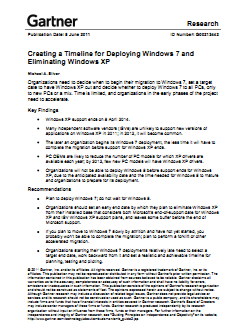
Gartner published an interesting research report about migration techniques & the imminent dangers or remaining on Windows XP in the upcoming 2012 year. 

They highlight the following concerns about not migrating off of Windows XP:

  • The end of vulnerability & security patches for Windows XP, leaving PCs exposed to new & upcoming malware
  • The continued elimination of support for Windows XP drivers by hardware vendors
  • The upcoming elimination of Windows XP support by line-of-business software vendors
  • The need to purchase custom support to protect & secure remaining PCs, agreements for which cost as much as $500,000/annually

Gartner’s advice around migration off of Windows XP is quite clear in their recent Research Report, "Creating a timeline for Deploying Windows 7 & Eliminating Windows XP" & it begins with, “Plan to deploy Windows 7; do not wait for Windows 8.”

There are however several other recommendations & we have received permission to distribute this analysis/report.  A publicly available link to the content is attached below for your reference.

We just released a new 365 page eBook from the Patterns and Practices series:  “A Guide to Claims-Based Identity and Access Control, Second Edition”.

imageAs an application designer or developer, imagine a world in which you don’t have to worry about authentication. Imagine instead that all requests to your application already include the information you need to make access control decisions and to personalize the application for the user.

In this world, your applications can trust another system component to securely provide user information, such as the user’s name or email address, a manager’s email address, or even a purchasing authorization limit. The user’s information always arrives in the same simple format, regardless of the authentication mechanism, whether it’s Microsoft® Windows® integrated authentication, forms-basedauthentication in a web browser, an X.509 client certificate, or something more exotic. Even if someone in charge of your company’ssecurity policy changes how users authenticate, you still get the information, and it’s always in the same format.

This is the utopia of claims-based identity that A Guide to Claims-Based Identity and Access Control describes. As you’ll see, claims provide an innovative approach for building applications that authenticate and authorize users.

Who This Book Is For
This book gives you enough information to evaluate claims-based identity as a possible option when you’re planning a new application or making changes to an existing one. It is intended for any architect, developer, or information technology (IT) professional who designs, builds, or operates web applications and services that require identity information about their users. Although applications that use claims-based identity exist on many platforms, this book is written for people who work with Windows-based systems. You should be familiar with the Microsoft .NET Framework, ASP.NET, Windows Communication Foundation (WCF), Microsoft Active Directory® directory service, and Microsoft Visual C#® development system.

image

The definition, business value, and technology benefits of the “the cloud” have been hotly debated in recent months. Most agree that cloud computing can accelerate innovation, reduce costs, and increase business agility in the market. In 2012, cloud computing will transition from hype and discussion, to part of every enterprise’s reality, and IT is uniquely positioned to lead this transformation and help business reap the benefits of cloud computing.

Join us for a virtual event designed to help you explore your cloud options. It’s your chance to interact with Microsoft experts and with IT leaders like yourself, who have been putting cloud technology to work in their own organizations. You’ll be among the first to hear the latest private cloud news from Microsoft.

  • Welcome remarks by tech-expert and journalist, Christine Chen
    8:30AM PST/4:30PM GMT
  • Private Cloud thought leadership panel and Live Q&A with Microsoft senior executives
    8:40AM PST/4:40PM GMT
  • Envisioning Your Private Cloud; Scenario-based demonstration of Microsoft’s Private Cloud computing solutions
    9:40AM PST/5:40PM GMT
  • Closing remarks and next steps
    10:25AM PST/6:25PM GMT

Microsoft Executive Panelists:

clip_image001Satya Nadella
President, Server
and Tools Business, Microsoft


clip_image002Brad Anderson
Corporate Vice President, Management and Security Division, Microsoft

clip_image003Jacky Wright
Vice President, IT Strategic Services, Microsoft IT


DATE/TIME:
Tuesday, January 17th
8:30 AM PST | 4:30 PM GMT

REGISTRATION:
http://www.microsoft.com/business/events/en-us/PrivateCloudExec/#fbid=uZYzH12-8yp

imageOur IT organization likes to say that they’re Microsoft’s first & best customer, because we deploy our products internally within Microsoft before they’re ever available to our customers.

As part of that effort, they document their work and summarize it in case studies and whitepapers which are often very useful for folks implementing the same products.

Here’s a listing of their most recent content:

New or updated content

New Readiness & Delivery Content

New Webcasts & Audiocasts

imageA customer asked the question:  Doesn’t the elimination of Single Instance Storage in Exchange Server 2010 mean that our Exchange stores are going to balloon in size?

We addressed this back in February. 
We HAD to change our storage architecture to provide dramatically better IO performance, huge increases in scalability, and more flexible.

One of our main goals for Exchange 2010 was to provide very large mailboxes at a low cost. Disk capacity is no longer a premium; disk space is very inexpensive and IT shops can take advantage of larger, cheaper disks to reduce their overall cost. In order to leverage those larger capacity disks, you also need to increase mailbox sizes (and remove PSTs and leverage the personal archive and records management capabilities) so that you can ensure that you are designing your storage to be both IO efficient and capacity efficient.

During the development of Exchange 2010, we realized that having a table structure optimized for SIS was holding us back from making the storage innovations that were necessary to achieve our goals. In order to improve the store and ESE, to change our IO profile (from many, small, random IOs to larger, fewer, more sequential IOs), and to resolve our inefficiencies around item count, we had to change the store schema. Specifically, we moved away from a per-database table structure to a per-mailbox table structure.

This architecture, along with other changes to the ESE and store engines (lazy view updates, space hints, page size increase, b+ tree defrag, etc.), netted us not only a 70% reduction in IO over Exchange 2007, but also substantially increased our ability to store more items in critical path folders.

The outcome was a bit of Exchange database growth.  To compensate for this we effectively implemented compression which eliminated the growth side effect.

As a result of the new architecture and the other changes to the store and ESE, we had to deal with an unintended side effect. While these changes greatly improved our IO efficiency, they made our space efficiency worse. In fact, on average they increased the size of the Exchange database by about 20% over Exchange 2007. To overcome this bloating effect, we implemented a targeted compression mechanism (using either 7-bit or XPRESS, which is the Microsoft implementation of the LZ77 algorithm) that specifically compresses message headers and bodies that are either text or HTML-based (attachments are not compressed as typically they exist in their most compressed state already). The result of this work is that we see database sizes on par with Exchange 2007.

Here’s the articles from the Exchange Team Blog that talk about why SIS’s removal from Exchange 2010 ends up being a really good thing!

Posted by: kurtsh | December 14, 2011

NEWS: Windows XP & Office 2003 end-of-lifeing in 27 months

One of my TAMs sent a mail out to our customers and I thought this part was exceptionally important for people to understand:

imageWindows XP SP3 and Office 2003 will no longer be supported from April 8, 2014 onwards. After this date, Microsoft will not provide any public support for these products, including security patches, non-security hotfixes or incident support.

Running Windows XP SP3 and Office 2003 in your environment after their end of support date may expose your company to potential risks, such as: 

  • Security & Compliance Risks – Unsupported and unpatched environments are vulnerable to security risks. This may result in an officially recognized control failure by an internal or external audit body, leading to suspension of certifications, and/or public notification of the organization’s inability to maintain its systems and customer information.
  • Lack of Independent Software Vendor (ISV) & Original Equipment Manufacturer (OEM) Support – A recent industry report from Gartner Research suggests "many independent software vendors (ISVs) are unlikely to support new versions of applications on Windows XP in 2011; in 2012, it will become common". And it may stifle access to hardware innovation: Gartner Research further notes that in 2012, most PC hardware OEMs will stop supporting Windows XP on the majority of their new PC models. See Creating a Timeline for Deploying Windows 7 and Eliminating Windows XP SP3, June 2011.

Do the math:

  • If your company has 10,000 desktops, assuming you start right now, you will need to deploy 370 Windows 7 desktop images every month, or 75 desktops a week in order to make the April 2014 deadline.
  • If your company has 3,000 desktops, you need to be able to deploy 111 Windows 7 desktop images each month.

Ask yourself:  Could you do this?  Do you have the time & the manpower?

We have a massive in-person training coming up in April for Lync 2010 that will touch architecture, voice integration, administration, support, etc.  We are funding the entire thing and spaces are filling up FAST so if you’re interested (assuming you’re a managed customer of mine), ping me and I’ll hook you up.

imageMicrosoft Lync Server 2010 Ignite
April 16 – April 20, 2012
Seating is limited – Register to save your spot today!

As a valued member of the Microsoft community, we would like to extend to you an official invitation to the 5 day Lync Server Ignite training event.

Course Description: This 5 day Lync Server 2010 Ignite training event includes deep technical content that covers a variety of workloads such as deployment, management, voice, conferencing high availability, and monitoring. This content is aimed at IT Pros and Partners who are responsible for deploying the various workloads of Lync Server 2010 and managing the deployments.

  • Module 1: Lync 2010 – What is New?
  • Module 2: Microsoft Lync Server 2010 – What is New?
  • Module 3: The Voice Story
  • Module 4: Setup and Deployment
  • Module 5: Management and Admin Experience
  • Module 6: Migration and Coexistence
  • Module 7: Instant Messaging and Presence Experience
  • Module 8: Meeting and Collaboration Experience
  • Module 9: Voice Experience
  • Module 10: Enhanced 9-1-1 and Location Services
  • Module 11: What is New in Devices?
  • Module 12: High Availability and Resiliency
  • Module 13: Voice Quality Considerations
  • Module 14: Network Assessment
  • Module 15: Bandwidth Management & Call Admission Control
  • Module 16: Edge Server / Remote Access
  • Module 17: Voice Applications
  • Module 18: The Unified Communications Developer Platform
  • Module 19: Monitoring and Troubleshooting
  • Module 20: Hybrid Scenarios

We look forward to having you participate in this exciting training event!

RSVP: This special, no charge training event will fill quickly and space is limited, so be sure to register as soon as possible to reserve your seat.  Please contact me if you are a managed customer of mine for registration details.

Who Should Attend:
This course is intended for the experienced IT Professional…

Prerequisites:
The following prerequisites are recommended:

  • Experience with Microsoft Networking
  • Experience with Windows Server 2008
  • Experience with Microsoft Office Communications Server 2007
  • Knowledge of telephony suggested

imageSprint weathered the challenges and reaped the rewards of killing off PBX systems and moving to a unified communications suite with Microsoft Lync.  The cost savings they’ve calculated are nothing less than spectacular, and they reflect the same sort of cost savings that Microsoft has seen in moving to a Lync-based Unified Communications solution for voice, video, and data communications/conferencing.

NET NET:  Sprint displaced their Nortel PBX for 40,000 users & are now evaluating Office 365’s Lync Online for Cloud-based access to Lync services. 

Taken from the article:

  • Moving from TDM (Time-Division Multiplexing) circuits to a SIP (Session Initiation Protocol) architecture to enable VoIP for 450 Sprint sites: $6.7 million in savings.
  • Eliminating bi-annual PBX upgrade costs: $2.5 million in savings.
  • Web conferencing costs _ Moved from a third-party conferencing provider to Lync Live Meeting: $300,000 a month.
  • "Green" savings from eliminating the need to power and cool legacy PBX equipment: $700,000 annually.
  • Real estate savings from the reduction in rented square footage (1.5 million square feet and counting): $30 million annually.

Read the entire article at CIO magazine:

Posted by: kurtsh | December 8, 2011

TOOLS: eBooks & References for PowerShell 2.0

Powershell2Unfortunately, there are no “freely available” eBooks on PowerShell 2.0 from Microsoft.  The two current books that we have available on version 2.0 are below.

We do have an OLDER PowerShell eBook available (1.0) for download here, which includes demo files and code:

In the meantime, you may want to review the following FREE eBooks on PowerShell v2.0:

imageAlso DZone created this quick reference chart for PowerShell users:

Posted by: kurtsh | December 6, 2011

RELEASE: Microsoft Assessment and Planning Toolkit 6.5

imageThe Microsoft Assessment and Planning (MAP) Toolkit is an agentless, automated, multi-product planning and assessment tool for quicker and easier desktop and server migrations. MAP provides detailed readiness assessment reports and executive proposals with extensive hardware and software information, and actionable recommendations to help organizations accelerate their IT infrastructure planning process, and gather more detail on assets that reside within their current environment. MAP also provides private and public cloud planning assessments, and server utilization data for Hyper-V server virtualization planning; identifying server placements, and performing virtualization candidate assessments, including ROI analysis for server consolidation with Hyper-V. Other significant new features in MAP 6.5 include the discovery of active Windows devices, Software Usage Tracking for Forefront Endpoint Protection (FEP), and the discovery of Oracle instances on Itanium-based servers with HP-UX to assist in the planning of migration to SQL Server. Learn more.

MAP is one of the tools provided by the Microsoft Solution Accelerators team. The Microsoft Assessment and Planning Toolkit, Microsoft Deployment Toolkit, and Security Compliance Manager provide tested guidance and automated tools to help organizations plan, securely deploy, and manage new Microsoft technologies—easier, faster, and at less cost. All are freely available, and fully-supported by Microsoft. Learn more.

For home users and users with a few computers to migrate, use the Windows 7 Upgrade Advisor to understand the readiness of your computer for Windows 7.
The MAP Toolkit includes the following components:

  • Microsoft_Assessment_and_Planning_Toolkit_Setup.exe. Installation package containing the tool, release notes, Getting Started Guide and toolkit help (chm file).
  • readme_en.htm. Available as a separate download. Provides information to read before installing the MAP Toolkit, including installation prerequisites and known issues.
  • Getting_Started_Guide.en.doc. Provides information about toolkit installation, environment preparation, and assessment scenarios supported by toolkit wizards and the UI.
  • MAP_Training_Kit.zip. Available as a separate download. Contains sample databases and training materials.
  • MAP_Sample_Documents.zip. Available as a separate download. Contains sample reports and proposals.

DOWNLOAD: Microsoft Assessment and Planning Toolkit 6.5
http://www.microsoft.com/download/en/details.aspx?displaylang=en&id=7826

« Newer Posts - Older Posts »

Categories