 Microsoft shipped a NEW sync client for OneDrive & OneDrive for Business cloud file storage services. As of this week, Microsoft made the new sync client’s usage mandatory if you wish to continue to sync your OneDrive for Business files. (This applies if you have fewer than 250 clients in your organization. Office 365 tenants with more than 250 clients will not have this requirement placed on them)
Previously there were separate sync clients for each service: One for OneDrive & one for OneDrive for Business. As of a month or so ago, there is now a NEW single client for syncing files from BOTH services. (Users that need to sync SharePoint document repositories will ALSO need to install/maintain the old OneDrive for Business client to continue to sync those files)
BACKGROUND
Microsoft has 2 services for cloud file storage: OneDrive & OneDrive for Business.
- OneDrive is a consumer service designed to provide anyone with 5GB or more of free online file storage (The storage a user has can be as high as 1TB, if the user also has a Office 365 Home subscription)
- OneDrive for Business is a commercial service that provides business users that are subscribed to certain Office 365 plans “unlimited cloud file storage”. (There is an initial cap of 10TB by default per user, however this can be increased upon request)
Each of these services PREVIOUSLY had separate sync clients – or separate software that would synchronize files between their Windows computer & the cloud file storage service.
ONLY ONE “SYNC CLIENT” EXISTS FOR ONEDRIVE & ONEDRIVE FOR BUSINESS 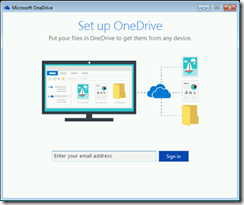 As of this winter, the sync client for BOTH OneDrive (Consumer) and OneDrive for Business are one and the same. A single sync client is installed & used to synchronize files from both services.
Click here to help determine which OneDrive sync client am I using?
To get the next-gen sync client for both services, download it here:
You can install & configure the OneDrive “next gen” sync client to sync files to your local machine using:

The next gen sync client, despite being a single client, will have 2 icons in the system tray once configured properly: OneDrive Consumer sync (circled in GREEN) & OneDrive for Business sync (circled in RED)
If you previously used the old OneDrive (Consumer) & OneDrive for Business sync client, you will find that after the new “next gen” OneDrive sync client will automatically take over the configuration & responsibility for synchronization of your OneDrive (Consumer) file sync & you’ll find that the old OneDrive (Consumer) client will have been uninstalled.
This is not the case for OneDrive for Business file sync.
CONFIGURING THE NEXT GEN SYNC CLIENT FOR YOUR ONEDRIVE FOR BUSINESS
Even after the next-gen sync client is installed, your OneDrive for Business files will continue to be synchronized by the OLD OneDrive for Business client, which should still be installed and exist in your Start Menu. See below:
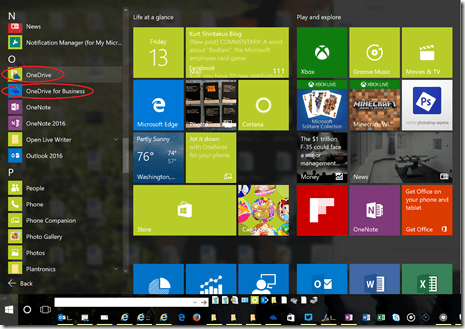
There are 2 OneDrive clients for Windows today: One is used for both OneDrive (Consumer) & OneDrive for Business file sync. This is the application listed (above) in the START menu as “OneDrive”.
The other client is the old, legacy “OneDrive for Business” client that is listed separating the START menu (above) and is still available but only for syncing SharePoint document shares.
The reason for this is that the old OneDrive for Business client is still required if you need to sync SharePoint document repositories to your local PC. For this reason, the next gen sync client LEAVES ONEDRIVE FOR BUSINESS ALONE.
You will however need to manually configure the next gen sync client you just installed to also sync your OneDrive for Business files. (If you are syncing SharePoint document repositories, those will continue to be synced by the old OneDrive for Business client and will need to remain installed)
To configure the next gen sync client to sync your OneDrive for Businesss files, you need to simply add your work account by launching the OneDrive sync client, assuming it’s been properly installed. Click the link below to start this process:
Go to the following link for more information on on the manual configuration process:
SYNCING SHAREPOINT DOCUMENT REPOSITORIES
If you need to sync files to your local machine from SharePoint document repositories, you will need to continue to use the original OneDrive for Business sync client. If you were using it previously, it should still be installed and still be running on your PC.

The old OneDrive for Business sync client continues to sync SharePoint document folders via the icon circled in LIGHT BLUE in the system tray, alongside the two icons controlled by the new next gen sync client for OneDrive.
If you need to download or install the old OneDrive for Business sync client to sync with SharePoint document stores, (also known as the Groove client) download it here:
- How to install the OneDrive for Business sync client for SharePoint 2013 and SharePoint Online
(Note: This is for the preview version of the OD4B sync client and NOT the next-gen sync client)
https://support.microsoft.com/en-us/kb/2903984
FOR IT ADMINISTRATORS
We have documentation for IT admins dealing with this OneDrive sync client transition.
Comments Off on INFO: Upgrading to the “next-gen” sync client (for OneDrive for Business users)
Posted in Uncategorized








 kurtsh


You must be logged in to post a comment.