imageLearning Pathways is a a collection of self-guided learning journeys to help you with your ongoing professional development.

These guides are one-page overviews that are HYPERLINKED and show the available training available for the subject.  They act as learning companions to the Enterprise Skills Initiative and are available in the following categories:

Infrastructure:

  • Azure Administrator
  • Azure VMWare Solution
  • Azure Solution Architect
  • Azure Network Engineer
  • Stack Hub Operator

Data & AI:

  • Data Skills (Aspiring Analyst)
  • Power BI Data Analyst
  • Data Engineer
  • Azure Synapse Analytics
  • Azure Database Admin
  • Azure Data Scientist
  • AI Engineer
  • Microsoft Purview

Security:

  • Security Operations Analyst
  • M365 Security Admin
  • Azure Security Engineer
  • Identity and Access Admin
  • Information Protection Admin
  • Microsoft Sentinel

Development:

  • Azure Developer
  • Azure DevOps
  • GitHub Learning

Other:

  • Microsoft Cost Management
  • Digital Skills > Cloud
  • Microsoft Teams

AWS-to-Azure:

  • Azure for AWS Architects
  • Azure for AWS Developers
  • Azure for AWS SysOps

To download the guides. visit:

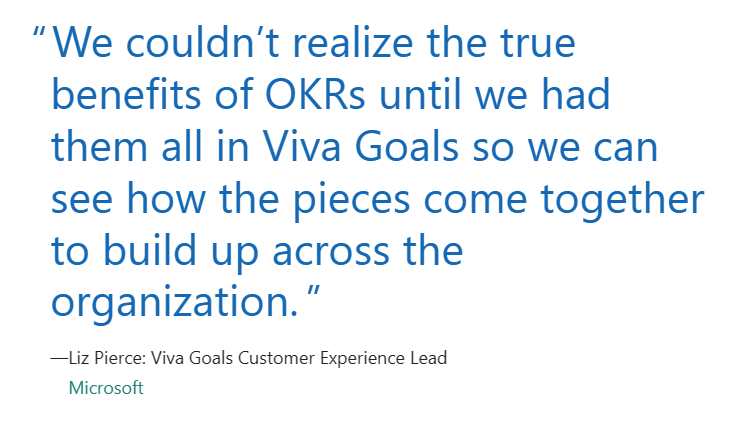
imageMicrosoft is seeing impact from Viva Goals and we are working with many clients to do the same.

Here’s what Ian Story, Directory of Product Development for SharePoint Syntex at Microsoft, has to say about working with our OKR tools.

“All businesses need to have objectives and key results to understand how they’re doing, particularly in times where we have to do more with less. In a business like mine – Microsoft Syntex – we see that OKRs save us time and keep alignment when we are all very busy. We use Viva Goals to track our OKRs and make sure that we’re staying on track, optimizing our investments, and driving business performance for Syntex while we help all our customers achieve more.”  

Read more about how Microsoft Viva is being developed and deployed at Microsoft:

#microsoftsyntex #syntex #microsoftteams #vivagoals #okrs

Posted by: kurtsh | February 13, 2023

NEWS: Microsoft & Artificial Intelligence Announcements

MicrosoftOpenAITimelineMicrosoft has made 6 major announcements in the past few weeks regarding artificial intelligence.

  1. Microsoft OpenAI partnership
  2. GPT & Bing & Edge
  3. GPT & Viva Sales
  4. GPT & Teams Premium
  5. Microsoft on Responsible AI
  6. General availability of “Azure OpenAI Service”

Additionally, Microsoft previously announced exclusive licensing of GPT-3 language model.

For State & Local Government decision makers, the opportunity is excellent:

Azure has made OpenAI services available in “commercial” tenants:

There’s been lots of coverage from the press.

imageA new paperback book that examines the use of Generative AI for State & Local Government scenarios was released earlier this month:

"Generative Artificial Intelligence Use Cases in State & Local Governments" is a groundbreaking book that explores the numerous ways in which AI can be harnessed by government entities at the state and local levels to enhance their operations and services.

The book provides a comprehensive overview of AI technologies and their potential applications, including:

  • predictive maintenance
  • fraud detection
  • budget forecasting
  • grant application review
  • and much more

With real-world case studies and examples of AI deployments, the book illustrates the tangible benefits that can be achieved by incorporating these technologies into government operations.

The book also provides practical guidance on how to plan and implement AI projects, including best practices for data management, ethical considerations, and how to foster collaboration between AI practitioners and government officials.

Whether you are a government executive, an AI professional, or simply interested in the role of technology in the public sector, this book is an essential resource for anyone looking to understand the future of AI in state and local governments.

Get the book here on Amazon:

imageSome organizations have users that switch computers often and require the use of Microsoft 365 Apps such as Word, Excel, PowerPoint, etc.  Each time they switch computers, one of their 6 license activations are used… until there are no more activations are left.

If this becomes a problem for your users, the user that’s “maxed out” their Microsoft 365 Apps installations may “deactivate previous device installations” that have been used on their own.
 
Deactivate an installation of Office – Microsoft Support

If you have an Microsoft 365 subscription, you can sign out of Office on a PC or Mac remotely from any web browser to deactivate the installation. Because Office will sign you out of devices automatically to stay within your sign-in limit, there’s no longer a need to use this process to free up installs. For more info, see How sign in works in Microsoft 365.

Note: Signing out of Office doesn’t uninstall Office, remove Office documents, or cancel your Microsoft 365 subscription.

Alternatively, you may leverage Microsoft 365 Apps via “Shared Computer Activation”.
 
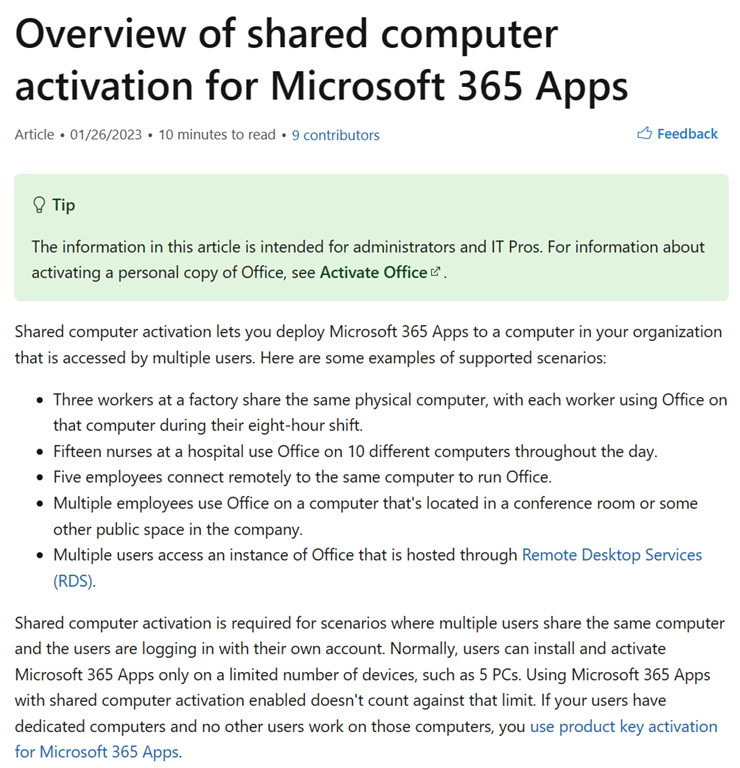
Overview of shared computer activation for Microsoft 365 Apps – Deploy Office | Microsoft Learn

Shared computer activation lets you deploy Microsoft 365 Apps to a computer in your organization that is accessed by multiple users. Here are some examples of supported scenarios:

  • Three workers at a factory share the same physical computer, with each worker using Office on that computer during their eight-hour shift.
  • Fifteen nurses at a hospital use Office on 10 different computers throughout the day.
  • Five employees connect remotely to the same computer to run Office.
  • Multiple employees use Office on a computer that’s located in a conference room or some other public space in the company.
  • Multiple users access an instance of Office that is hosted through Remote Desktop Services (RDS).

Shared computer activation is required for scenarios where multiple users share the same computer and the users are logging in with their own account. Normally, users can install and activate Microsoft 365 Apps only on a limited number of devices, such as 5 PCs. Using Microsoft 365 Apps with shared computer activation enabled doesn’t count against that limit.

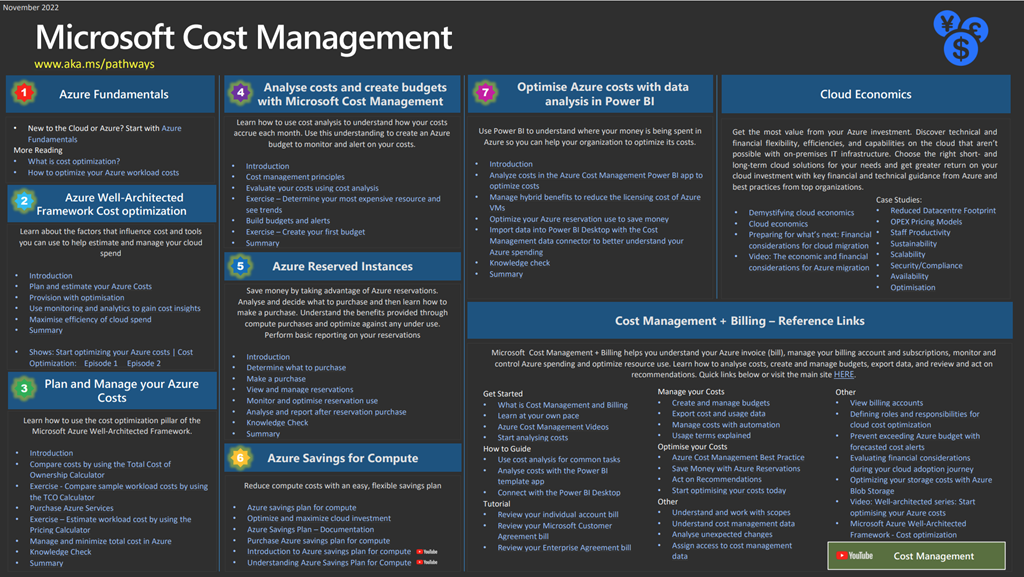
For folks looking for information on how to use Azure Cost Management, Here’s some self-service, on-demand content for you and your team to take advantage of to get started:

OPTIONAL – For customers with Unified Support
There is a fantastic proactive offering that has a Customer Engineer train you on the usage of the Cost Management service.

  • “AZURE COST MANAGEMENT PLANNING” workshop through Unified Support
    Most of my customers take the 5-day Azure Cost Management workshop that Unified Support offers (a proactive offering) because it gets you access to a Customer Engineer who – on the West Coast – is an absolute wizard.

    Contact your Unified Support Customer Success Account Manager for details and the datasheet for the engagement.

imageCreate a Zero Trust adoption plan that accommodates your organization’s unique risks and capabilities. With this flexible playbook, get foundational action items that help you strengthen security across six key risk areas.

Download The Comprehensive Playbook for a Zero Trust Security Strategy to:

  • Identify small changes that can make big improvements to your security.
  • Understand how deeper integration of key security pillars can simplify policy enforcement.
  • Learn how Zero Trust can increase efficiency and productivity in security posture management.

Get the playbook here:

imagePlease be aware of the upcoming retirement of Microsoft Software Assurance Benefits (SAB) “24/7 Problem Resolution Incidents”. We will fully retire the “24×7 Problem Resolution Support” benefit from Software Assurance for all Microsoft customers effective February 1, 2023.

  • New SAB 24×7 PRS incidents won’t be allocated starting February 1st, 2023. Customers will continue to earn SAB 24×7 PRS incidents until January 31st, 2023, to transfer towards their Support contract.
  • Customers’ available SAB 24×7 PRS incidents must be transferred to their Support contract using the current transfer process before February 1st, 2023. Any unused incidents will expire.

For more information, please see:

Please contact your Microsoft Customer Success Account Manager for more information.

If you’re responsible for Azure Active Directory & use Azure AD Multi-factor Authentication… important notice:

HOWTO: Mitigating MFA authentication spamming with Azure AD MFA Number Matching
You may have heard recently about a technique used by bad actors called “authentication spamming” or “MFA phishing”.  It’s a method by which bad actors rapidly send MFA authentication messages to an end user in the hopes that they will “get annoyed” and eventually simply “approve” the authentication request to make it go away… allowing the bad actor access to your network.  (The technique is described in this article by our Director of Identity Solutions, Alex Weinart, here: Defend your users from MFA fatigue attacks)

clip_image001Solution: Azure AD MFA Authenticator Number Matching
If you are using Azure AD Multi-factor Authentication, we at Microsoft have implemented a technology in Azure AD MFA called “number-matching” which has dramatically helped to mitigate “authentication spamming” (MFA phishing) attacks while making it available for everyone in the world to use free of charge. We highly recommend enabling number matching ASAP for improved sign-in security.

Mandatory Enforcement – COMING FEBRUARY 27TH, 2023
We will be removing the admin controls and enforce the number match experience tenant-wide for all users starting February 27, 2023. i.e. Your staff will be required to use "number matching" when using Microsoft Authenticator as of March 1, 2023, so please investigate the implementation of number matching to eliminate authentication phishing in your organization immediately.

HOWTO: Deploy Azure AD MFA Number Matching
The following is a step-by-step guide on how to implement MFA number-matching on Microsoft Azure Active Directory & Microsoft Authenticator.

Assistance with Configuration
If you need assistance with getting this configured, contact your Microsoft Unified Support Customer Success Acct Mgr or your FastTrack Manager.

Posted by: kurtsh | January 26, 2023

NEWS: Microsoft & OpenAI “ChatGPT”

imageThere’s been a lot of news about the next-generation capabilities of ChatGPT.  If you’re trying to figure out what ChatGPT is, the good news is that it’s super easy to understand and get started.

  • WHAT IS IT? 
    ChatGPT is a services from “OpenAI” that leverages it’s GPT-3 family of large language models.
  • HOW IS IT USEFUL? 
    It’s used with chatbots to deliver incredibly natural, powerful conversations.  It is a generational leap for artificial intelligence based chats.
  • WHAT IS "’GPT’? 
    Generative Pre-trained Transformer – a advanced language model that leverages relies on deep learning for human-like responses using publicly available datasets.  They call the solution “ChatGPT” because it uses the GPT language model.

What is Microsoft’s relationship with ChatGPT?
If you are leveraging Microsoft technology today, Microsoft has a multi-billion dollar partnership with OpenAI, the basis of ChatGPT, and is it’s largest founding partner.  As such:

  • Microsoft Azure will be the exclusive cloud provider for OpenAI & exclusive licensee for the GPT-3 language model used in ChatGPT.
  • Microsoft has released Azure OpenAI Service, an enterprise-class delivery of OpenAI capabilities.
  • Microsoft intends on leveraging OpenAI services, including ChatGPT, throughout it’s entire cloud portfolio including Microsoft 365, Azure & Dynamics 365.

Getting started with ChatGPT:

In order to get going with ChatGPT & all OpenAI services, sign up at the site below:

« Newer Posts - Older Posts »

Categories