imageUnified Communications and Collaboration Ignite – 3 Day Training Event
Seating is limited – Register to save your spot today!

Dates: March 22-24, 2011
Location:
Irvine, CA
Register:  Contact me if you are a customer for registration details.

As a valued member of the Microsoft community, we would like to extend to you an official invitation to the 3 day Unified Communications and Collaboration (UCC) Ignite training event.

  • Day 1 Essentials of Exchange Server 2010 SP1
  • Day 2 Essentials of Lync Server 2010
  • Day 3 Collaboration capabilities of Sharepoint 2010, Lync and Exchange Server 2010 SP1 together

Please note that we can only guarantee your seat for a limited time, so please RSVP early!

The UCC Ignite Instructor-led, hands-on technical training is the best way for you to get a first look at the communications and collaboration capabilities of these 3 products! During the event, you will have the opportunity to learn about technical details and key features, complemented by multiple hands-on labs.

Workshop Agenda

Daily 8:30AM Check-in / 9:00AM Start

DAY 1: Exchange Server 2010 SP1

  • Lecture: Overview New Features
  • Lecture and Lab: Client Access
  • Lecture and Lab: Information Leakage Protection and Control
  • Lecture and Lab: Management Tools and Role-Based Access Control
  • Lecture and Lab: Transport and Routing
  • Lecture and Lab: High Availability

DAY 2: Lync Server 2010

  • Lecture: Overview of Lync Server 2010
  • Lecture and Lab: Architecture, Planning & Deployment
  • Lecture and Lab: Presence and Unified Client
  • Lecture and Lab: Voice Features
  • Lecture and Lab: Unified Messaging Integration – Microsoft Exchange Server 2010 SP1 and Lync Server 2010
  • Lecture and Lab: New Features of Lync Server 2010

DAY 3: Collaboration using Sharepoint 2010, Exchange Server 2010 SP1, & Lync Server 2010

  • Lecture: Overview Sharepoint 2010 Integration Features
  • Lecture and Lab: Sharepoint with Exchange
  • Lecture and Lab: Sharepoint Workspaces with Outlook and Exchange
  • Lecture and Lab: Sharepoint with Lync Server 2010
  • Lecture and Lab: Exchange and Lync Server 2010

Note: Lunch will be provided each day.

We look forward to having you participate in this exciting training event!

  • Location:  Microsoft Office
    3 Park Plaza
    Suite 1800
    Irvine, CA 92614
    (949) 263-3000
  • Date/Time:
    March 22, 2011
    9:00am- 5:00pm (PST)

DAY 1 Exchange Server 2010 SP1

  • New Features
  • Client Access
  • Information Leakage Protection
  • Transport and Routing
  • High Availability
  • Management Tools and Access Control

DAY 2 Lync Server 2010

  • Architecture, Plan & Deploy
  • Presence and UM
  • Voice Features
  • UM Integration with Exchange
  • New Features

DAY 3 Collaboration with Sharepoint 2010

  • Sharepoint 2010 Integration Features
  • Sharepoint w/ Exchange
  • Sharepoint Workspaces
  • Sharepoint w/ Lync
  • Exchange w/ Lync

imageHuge news.  Developers using the world’s most popular development language can now write Windows Phone 7 applications!  As taken from the Windows Blog:

Back in September, we released the CTP of Visual Basic for the Windows Phone Developer Tools. Today we’re pleased to announce the immediate availability of the RTW version of the Visual Basic add-on. You can immediately download VB support for the Windows Phone developer tools.

The big news is that you can now build and release Silverlight applications and games for Windows Phone built in Visual Basic to the Windows Phone Marketplace.

In addition, we’ve spent time beefing up our VB for WP sample code. Check out new VB versions of our released samples on MSDN.

We’re extremely excited to officially add support for Visual Basic to Windows Phone, and we can’t wait to see all of the new apps and games you’ll create with it.

For more information about this release, check out the following resources:

  • The Visual Basic team’s blog
  • Soma’s announcement of the release on his blog
  • Jason Zander’s blog post on the release

Please note the following:

  • This initial release of the Visual Basic add-on for the Windows Phone Developer Tools requires Visual Studio 2010 Professional or higher; Visual Studio 2010 Express for Windows Phone is not supported. If you do not have VS 2010 Pro or higher, you can download a trial version here.
  • This release is only for Silverlight projects only; the Visual Basic add on for the Windows Phone Developer Tools does not support projects built on the XNA Framework.

Larry Lieberman, Product Manager, Windows Phone Developer Experience

Posted by: kurtsh | December 2, 2010

WHITEPAPER: Windows Server Networking Guides

imageThe Windows Server Information Experience (WSiX) team has two new guides that are now available both on the Web and in the Microsoft Download Center:

Accomplish Goals with Windows Server Networking
In the guide "Accomplish Goals with Windows Server Networking," you’ll find networking goals that are presented in plain English so that you can find the right documentation, even if you aren’t yet familiar with all of the great Windows Server networking technologies.

You can find the guide in the Windows Server 2008 and Windows Server 2008 R2 Technical Library, at http://go.microsoft.com/fwlink/?LinkId=194635. And it’s now available in Word format at the Microsoft Download Center, at http://go.microsoft.com/fwlink/?LinkId=204707.

Network and Sharing Center Operations Guide
Also ready for viewing now is the “Network and Sharing Center Operations Guide” for Windows 7, Windows Server 2008 R2, Windows Vista, and Windows Server 2008. Network and Sharing Center provides a centralized location where you can view, create, and modify local area network (LAN), wireless local area network (WLAN), virtual private network (VPN), dial-up, and Broadband connections on your client and server computers. In addition, you can configure connections to the local computer, as well as  sharing options that specify the content that is available to other computers and devices on the network.

You can find the guide in the Windows Server 2008 and Windows Server 2008 R2 Technical Library, at http://go.microsoft.com/fwlink/?linkid=63530. This guide is also available in Word format at the Microsoft Download Center, at http://go.microsoft.com/fwlink/?LinkId=204708.

[taken from the EdgeAccess blog]

We received some great feedback from customers about deploying DirectAccess in their organizations. One notable quote was “it works like magic!” Our customers also told us how we can make the product better by adding features and making existing features easier to manage.

After discussions and prioritization we are now proud to present the DirectAccess enhancements in service pack 1:

  • One-time-password support including: Integrated RSA SecurID agent and support for other 3rd party RADIUS based OTP products
  • Added optional settings in each step for advanced deployment scenarios
  • Support for deploying DirectAccess Group Policy across multiple domains, and pre-created GPOs
  • Support for the “I only want to manage my computers” scenario using integrated UAG UI
  • Support for Force Tunneling scenario using integrated UAG UI
  • Integrated NAP for simplified endpoint policy enforcement with simple “for dummies” setup of NAP+DA and integrated NAP troubleshooting tools included in Web Monitor
  • Improved monitoring and troubleshooting

Read more at:
http://blogs.technet.com/b/edgeaccessblog/archive/2010/10/27/uag-sp1-da-overview.aspx

imageTaken from the “OutBlog”:

Have you visited Office.com recently? Microsoft offers free online video training courses that increase your Outlook 2010 productivity. Whether you’re new to Outlook, recently upgraded from Outlook 2003, or an experienced user that likes to organize your Inbox with the new Conversations view, there is something for you. Go here to check them out.

We’re also happy to introduce three new courses:

· Use e-mail signatures in Outlook 2010

· Get familiar with the Outlook Calendar

· Use electronic business cards in Outlook 2010

Check them out and let us know what you think in the comments. Feel free to suggest a topic for future trainings!

Posted by: kurtsh | December 1, 2010

INFO: What’s new with Lync 2010

imageBack in October, we officially announced the release to manufacturing of Microsoft Lync 2010 – the next release of Office Communications Server and Communicator. 

  1. Office Communications Server 2007 introduced Communicator and a totally new experience for enterprise IM, presence and conferencing built into the Office applications people use every day.
  2. Office Communications Server 2007 R2 added on premise audio conferencing that was easy to manage, saved customers money, added core enterprise telephony features, and better supported collaboration through richer online meetings and ad hoc conversations via Communicator. 

With the release of Lync 2010, we’re taking collaboration and productivity to the next level.

What’s new with Lync 2010?
Microsoft Lync Server 2010 now delivers complete presence, instant messaging, conferencing and enterprise voice capabilities through a single, easy-to-use interface that is consistent across PC, browser, and mobile device. Administrators benefit from a single, consistent management infrastructure, new capabilities to increase availability, and interoperability with existing systems.

  • Unified Experience
    • Get easy access to presence, instant messaging, voice, and audio, video, and Web conferencing—all from the new Microsoft Lync 2010.
    • Use one set of contacts across Microsoft Lync 2010 and Office applications.
    • Communicate with context from within the applications you use most, including Microsoft Outlook and Microsoft SharePoint.
    • Deliver access to presence, instant messaging, and other capabilities for workers on the go via PCs, browsers, and mobile phones.
  • Connect and Collaborate
    • Find the right people, make connections, and communicate more effectively with new rich presence features including pictures and location.
    • Leverage internal expertise more effectively with Microsoft SharePoint-based Skill Search.
  • Simple, Essential, Reliable Conferencing
    • Collaborate more effectively with built-in desktop and application sharing, PowerPoint upload, and rich white boarding, including the ability to copy and paste images and other content.
    • Schedule and join meetings with a single click in Microsoft Outlook or the meeting reminder.
    • Place attendees in a virtual lobby for greater security and control over who can attend.
  • Complete Enterprise Voice Features
    • Delight your users with the features they need, a wide range of IP and USB devices, and the ability to work in the office, at home, or on the road.
    • Architect your deployment for high availability using data center resiliency and survivable branch appliances.
    • Manage bandwidth utilization and increase Quality of Experience with Call Admission Control, QoS markings, and an adaptive media stack that works well even on unmanaged networks like the Internet.
    • Meet North American regulatory requirements with flexible Enhanced 9-1-1 capability.
  • Powerful Deployment and Management Tools
    • Work with a PowerShell-based foundation for administration consistent with Exchange Server, Active Directory, and other Microsoft server products.
    • Get consolidated management tasks in one location with dramatically improved navigation through the new Silverlight-based, scenario -driven unified graphical management tool.
    • Improve security and administrative productivity with Role-based Access Control (RBAC) with built-in and customer-defined roles.
    • Get support for server virtualization of most OCS roles.
  • Extensibility
    • Easily embed Microsoft Lync UI elements in your applications, build your own client experience in .NET with open and documented APIs, and enhance contextual collaboration by launching applications right from Microsoft Lync.
    • Get platform support for sophisticated contact center and help desk scenarios, enable access to all UC-enabled services from any phone, and deliver state-of-the-art speech technology in 26 languages.
    • Significantly simplify deployment, operations, and interoperability with added features that improve provisioning, load-balancing, fail-over, and draining.

For more information on Lync’s new themes, visit the following sites:

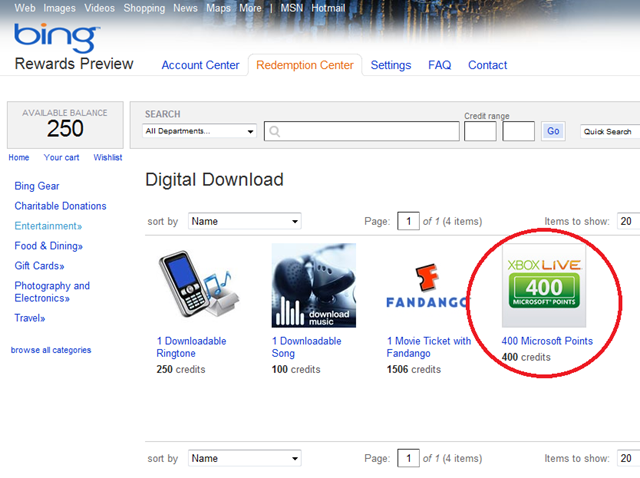
imageWant yet another reason to switch using Bing as your search engine?

You can earn 1 Microsoft Point for every search you do on Bing using the Bing Rewards program.

And here’s something even better:  When you sign up for Bing Rewards, you automatically receive 250 search credits – as if you’d already searched using Bing 250 times.

Bing’s every bit as good as Google for searches and in many scenarios, like air travel, sports scores, and other specific areas, it’s much better.  But just as importantly – if you’re gonna search the Internet, why not get paid for it?  Bing Rewards allows you do get PAID.

GETTIN’ PAID FOR YOUR INTERNET SEARCHING
It’s easy to start getting free Xbox Live credit just for searching the Internet.  How do you start, you ask?

  1. Sign up for Bing Rewards.  You’ll need to have a Windows Live ID.
    http://bit.ly/cx2Fui
  2. Install the Bing Toolbar & Bing Rewards BHO Helper Object.  The toolbar & Helper object helps keep track of each search.  NOTE:  It does NOT track what you searched for – only that you did in fact search the Internet using Bing.
  3. Be sure to configure the Bing Toolbar to log you in.
  4. Visit the Bing Rewards redemption page to redeem your points for Microsoft Point cards.  (400 point increments)
    https://ssl.bing.com/rewards/redeem/Product/Index?category_id=6493

That’s it.  Redeem your points after you get 400 searches. 

WARNING:  In order for you to get credit for your searches, you apparently have to search from either the Search field in Internet Explorer 8.0 or the Bing Search bar itself.  Otherwise you search count tally won’t increment.  (It shows your total number of searches in the Bing Bar itself.)

Posted by: kurtsh | November 17, 2010

TOOL: Windows Service Pack Blocker Tool Kit

imageA blocking tool is available for organizations that would like to temporarily prevent installation of Service Pack updates through Windows Update.
This tool can be used with:

  • Windows 7 Service Pack 1 (valid for 12 months following general availability of the service pack)
  • Windows Server 2008 R2 Service Pack 1 (valid for 12 months following general availability of the service pack)

This toolkit contains three components. All of them function primarily to set or clear a specific registry key that is used to detect and block download of Service Packs from Windows Update. You only need to use the component which best serves your organization’s computer management infrastructure.

  • A Microsoft-signed executable
  • A script
  • An ADM template
  1. The executable creates a registry key on the computer on which it is run that blocks or unblocks (depending on the command-line option used) the delivery of a Service Pack to that computer through Windows Update. The key used is HKLM\Software\Policies\Microsoft\Windows\WindowsUpdate.
    When the ‘/B’ command line option is used, the key value name ‘DoNotAllowSP’ is created and its value set to 1. This value blocks delivery of a Service Pack to the computer through Automatic Update or Windows Update.
    When the ‘/U’ command line option is used, the previously created registry value that temporarily blocked the delivery of a Service Pack to the computer through Automatic Update or Windows Update is removed. If the value does not exist on the computer on which it is run, no action is taken.
  2. The script does the same thing as the executable, but allows you to specify the remote machine name on which to block or unblock delivery of Service Packs.
    Note that the executable and script have been tested only as a command-line tool and not in conjunction with other systems management tools or remote execution mechanisms.
  3. The ADM template allows administrators to import group policy settings to block or unblock delivery of Service Packs into their Group Policy environment. Administrators can then use Group Policy to centrally execute the action across systems in their environment.

Please note that this toolkit will not prevent the installation of the service pack from CD/DVD, or from the stand-alone download package. This simply prevents the service pack from being delivered over Windows Update.

Posted by: kurtsh | November 16, 2010

INFO: SharePoint 2010 resources for IT Pros and Developers

imageThis is a aggregated list of SharePoint 2010 resources for IT Pros and also Developers.

IT Pro Resources

Training

Documentation

Downloads

Communications

Downloadable Books

Diagrams and white papers

Developer Resources

Training

Documentation

Code Samples

Community

ALM Resource Center | SharePoint 2010
Application Lifecycle Management is the coordination of all aspects of software engineering—including the formulation and communication of business and technical requirements, code design and architecture, project tracking, change management, coding, testing, debugging, and release management—by using tools that facilitate and track collaboration among and within work teams.
http://msdn.microsoft.com/en-us/sharepoint/dd552992.aspx

Solutions you develop internally or create for public consumption should function as designed when users upgrade to Office 2010. Here you will begin to learn what you need to know when you migrate existing application code. You can find information about application compatibility tools, programs, and guidance.

Tools and Guidance

clip_image002

Office 2010 Code Compatibility Inspector

The Office Code Compatibility Inspector for VBA and the Office Code Compatibility Inspector for Visual Studio are add-ins that you install with Office 2010 or Visual Studio. The tools scan VBA, VB.NET, and C# code for object model usage that is incompatible with Office 2010.

clip_image004

Office Environment Assessment Tool (OEAT)

This tool helps you determine the kinds of add-ins that are installed on users’computers and the extent to which the add-ins are used. OEAT collects and reports add-in information about Office 2000, Office XP, Office 2003, and the 2007 Office system.

clip_image006

Application Compatibility Assessment and Remediation Guide

The Application Compatibility Assessment and Remediation Guide for Office 2010 describes the overall assessment and remediation process, including planning, testing, piloting, and deployment.

Articles

Compatibility Changes Between Versions

Related Resources

Blogs

« Newer Posts - Older Posts »

Categories