Posted by: kurtsh | March 1, 2012

NEWS: SQL Azure pricing cut by ~50% or more

imageThis is insane.  I’m sorry but I just have to say that.  We’re basically slashing prices on SQL Azure by ~50%.
Crazy.

To meet evolving customer needs across both ends of the database size spectrum, we are lowering the price of SQL Azure and introducing a 100MB database option.

Customers will realize 48% to 75% savings for databases larger than 1GB. The 100MB DB option enables customers to get started using SQL Azure at half of the previous price, while still providing the full range of features including: high availability, fault tolerance, self-management, elastic scale-out, on-premises connectivity, and full Service Level Agreement. Full details on our new pricing can be found here.

Read more here:
http://blogs.msdn.com/b/windowsazure/archive/2012/02/14/announcing-reduced-pricing-on-sql-azure-and-new-100mb-database-option.aspx

imageI got this question from a customer today:

Q: Why should we use Forefront’s Antivirus technologies on our PCs?  Isn’t that the same thing as Microsoft Security Essentials?

There’s a very significant difference between the two:

  • Microsoft Security Essentials is the free antimalware service that provides real-time protection to consumers and small businesses to address the ongoing security needs of a genuine Windows PC, helping to protect it from viruses, spyware and other malicious threats.
  • Forefront Endpoint Protection 2010 provides endpoint protection for business environments, including not only antimalware, but behavior monitoring and firewall management protections. Forefront Endpoint Protection also includes central deployment, configuration, and reporting features needed for ensuring protection is maintained across the enterprise. Both Forefront and Microsoft Security Essentials share the same Antimalware Protection Platform and provide comprehensive security protection to their users.

FOR CONSUMERS
For consumers and very small businesses needing protection from malicious software including Spyware, Viruses, Trojans and rootkits, Microsoft Security Essentials is a free, high-quality anti-malware service that efficiently addresses the ongoing security needs of a genuine Windows-based PC. Forefront Endpoint Protection 2010 provides endpoint protection for business environments, including not only antimalware, but behavior monitoring and firewall management protections. Forefront Endpoint Protection also includes central deployment, configuration, and reporting features needed for ensuring protection is maintained across the enterprise

FOR ENTERPRISES
Forefront Endpoint Protection, the next generation release of Forefront Client Security, simplifies and improves endpoint protection while greatly reducing infrastructure costs. Built on System Center Configuration Manager 2007, it will allow customers to use their existing client management infrastructure to deploy and manage endpoint protection. This shared infrastructure lowers ownership costs while providing improved visibility and control over endpoint management and security.

New key features included in FEP include:

  • Integration with Configuration Manager. Single interface for managing and securing endpoints reduces complexity and improves troubleshooting and reporting insights.
  • New Antivirus Engine. Highly accurate and efficient threat detection protects against the latest malware and rootkits with low false positive rate.
  • New behavioral threat detection. Protection against “unknown” or “zero day” threats provided through behavior monitoring, emulation, and dynamic translation.
  • Windows Firewall management. Ensures Windows Firewall is active and working properly on all endpoints, and allows administrators to more easily manage firewall protections across the enterprise.

FOREFRONT HOST INTRUSION PREVENTION
One of the big inclusions within Forefront Endpoint Protection is Host Intrusion Prevention capabilities.

Host intrusion prevention includes a wide variety of technologies that help prevent unwanted activity on endpoint and server operating systems. These protections are spread across the application, file system, and network layers. Forefront Endpoint Protection incorporates several Host Intrusion Prevention technologies.

  • Application: Behavior monitoring
  • File System: Antimalware (known threats) and Dynamic Translation and Emulation (unknown threats)
  • Network: Windows firewall management

There is an additional vulnerability shielding technology, known as Network Inspection System (NIS), that is also in the Forefront Endpoint Protection 2010. Based on a similar technology found in Forefront Threat Management Gateway Web Protection Service, it is designed to protect endpoints against application-layer threats through signatures and a deep protocol and application analysis.

image

Forrester did a study of the benefits achieved by organizations using System Center Configuration Manager by deploying Forefront Endpoint Protection (FEP) 2010 and integrating their desktop management and security infrastructure.

Their study indicates a total Net Present Value (NPV) of almost $300k for a reference customer with 5000 seats.

Forrester interviewed eight FEP customers for this study.  Based on these interviews, we developed a composite organization with 5,000 endpoints, typically PCs running the Microsoft Windows operating system.  The composite organization has two security administrators and two desktop administrators and experiences approximately 200 malware incidents annually.  The financial analysis found that a composite organization experienced the risk-adjusted costs and benefits shown in Table 1.

Benefits.  The composite organization experienced the following benefits that represent those experienced by the interviewed companies.

  • Reduction in labor effort for malware remediation of $36,153
  • Reduction in labor effort for investigating malware alerts of $81,738.
  • Reduction in labor effort for client administration of $112,207.
  • Cost avoided by software maintenance fees of $134,041.

Click below to download the entire report:

image

The Windows 8 Consumer Preview Product Guide for Business provides a detailed look at the many new and improved features in Windows 8.

The guide is designed as an accurate source of information that can help businesses understand how Windows 8 enables users to be ready and productive practically anywhere, allows for a personalized user experience, and provides IT with more secure, easy-to-manage intelligent infrastructure.

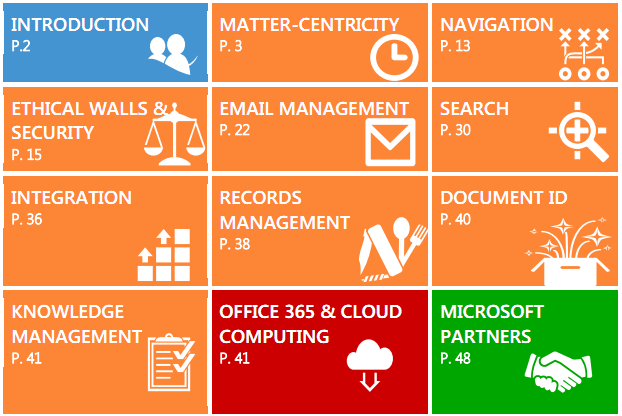
imageMicrosoft was a huge hit at LegalTech 2012 January 30-February 1, 2012. A full listing of the sessions presented during our Super Session is available on the “Featured Content for Law Firms” page on Microsoft.com.

Review the material there or click on one of the PowerPoint deck links below:

imageThis report provides an overview of critical legal Document Management System requirements, along with an explanation of how Microsoft products address those requirements.

We’ve also identified gaps in functionality and highlighted partners that can provide enhanced functionality to meet your legal needs.

We have focused on requirements that are specific to legal DMS, rather than covering the basic requirements of a standard document management system, which are easily satisfied with Office apps and SharePoint 2010.

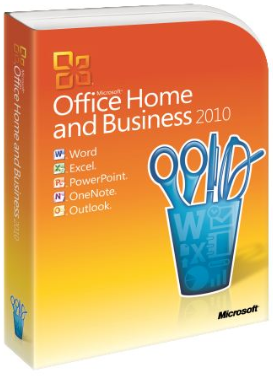
imageI got asked today by an Enterprise customer:

“Why should we buy Office Standard 2010?  Office Home & Business 2010 looks like the same thing but without Publisher 2010, and we don’t need Publisher 2010.”

The important thing to understand is that the difference between “Office Home & Business 2010” & “Office Standard 2010” is much more than “Publisher 2010”.

  • Office Standard 2010 is an Enterprise-class productivity suite designed for worldwide deployment & Enterprise integration.
  • Office Home & Business 2010 is a consumer/small business-grade suite designed for a single PC installation.

Here are some of the issues to consider:

  1. NO VOLUME LICENSING
    Enterprise customers licensing Office usually want to purchase it on volume to get the best discount for their volume purchase. Office Home & Business is a consumer purchase & cannot be licensed via Volume Licensing – i.e. there is no Select pricing.  Office Home & Business is a retail/OEM package SKU created primarily for consumers to purchase at a retailer like Best Buy/Costco for use on their home PC usually to complement the business edition they use at work – not for deployment in an Enterprise.  Office Standard is available for purchase through Volume Licensing and thus available for volume discounting & volume deployment.
    http://office.microsoft.com/en-us/buy/office-2010-volume-licensing-suites-comparison-FX101825637.aspx
  2. NO ENTERPRISE SOFTWARE DISTRIBUTION
    Enterprise organizations need to understand that Office Home & Business has no processes available for architecting an Enterprise deployment.  It cannot be feasibly deployed in volume via enterprise distribution technologies like System Center or Altiris due to a lack of volume activation technology.  There is no mass distribution packaging for this edition and more importantly, there is no volume activation/single Enterprise activation key available for this edition.  Each copy of Office Home & Business needs to be installed by hand (or come tied to a PC) and manually activated using an UNIQUE individualized activation key for each PC & this key essentially comes out of the retail package.
    Office Standard has many well-defined volume deployment processes available to it as well as volume activation for the entire enterprise using a single activation key for an elegant Enterprise deployment installation/image.
  3. NO OFFICE WEB APPS
    In WAN connected environments, minimizing the need to download/upload entire documents to editing & viewing is becoming increasingly important. Additionally, with the variety of devices in use by users today, being able to render Office documents through standards compliant platform agnostic browsers is important since it enables usage on connected iPads & other non-Windows platforms.
    Office Standard 2010 features the licensing rights to use Office’s web-based/HTML-based counterparts hosted internally on SharePoint Server, for individuals that want to access documents within a web browser.  This provides the convenience of reading/editing documents without downloading the file locally from a server and enables multi-person editing.  If the Office license is on Software Assurance, the user will have Office Roaming Use Rights and can access their documents via a HTML web browser over “Office Web Apps” on companion devices like iPads, Android Tablets, Macintoshes, etc.  without any additional licensing.  Office Home & Business does NOT have this licensing right & cannot use server-based Office Web Apps in any capacity.
  4. NO SUITE CUSTOMIZATION OR ENTERPRISE MANAGEMENT
    Most Office 2010 deployments require customization to ensure that the installation reflects the needs of the organization. This includes hundreds of functions and capabilities, not the least of which being setting the default saved document format is (.DOC, .DOCX, ODF, etc.), the security settings for permitting the opening of macros/documents, privacy settings such as document metadata, etc. Office Standard 2010 has the ability to modify these feature settings for enterprise deployments using the Office 2010 Customization Tool.  It also has the ability to use Group Policy templates to globally manage Office 2010 settings using Active Directory.  Office Home & Business does not have the technical ability to use the Office Customization Tool for customizing the Office suite for deployment (only volume licensed editions are capable), nor are Group Policies configurable for enterprise management use based on its terms of use.
    http://technet.microsoft.com/en-us/library/cc179097(office.14).aspx
  5. NO MULTILANGUAGE SUPPORT
    In order to support localized languages such as Spanish, French, German, etc., Office has Multilanguage Packs available for it that are installable. Office Standard 2010 has this available to it if it is covered by Software Assurance under volume licensing. Office 2010 Home & Business does not have Multilanguage Pack support in any capacity as this is exclusively a feature for Office Standard or Professional Plus.
  6. TECHNICAL FEATURE DIFFERENCES
    The technical difference between Office Home & Business 2010 & Office Standard 2010 as I stated earlier is more than just “Publisher 2010”.   The following technological features exist in Office Standard 2010 and are subsequently missing in Office Home & Business 2010:

    1. Information Rights Management & Policy Features
      IRM safeguards digital information from unauthorized use through integration with Windows Rights Management Services (RMS) for Windows Server. It gives users the ability to define exactly who can open, modify, print, forward, and/or take other actions with documents and e-mail messages.  Office Standard has the ability to consume and read IRM-protected content in Outlook, Word, Excel, and PowerPoint.  Office Home & Business do not have this capability in any of its products.
    2. Contextual access to business & social networking
      The social networking features of Office Standard provides a people-centric view of your company, including messages, meeting schedules, attachments, and SharePoint activities—such as the posting of status updates directly within Outlook.  It allows Office Standard users to connect to popular social networking sites to get news from customers, prospects, and partners.  Office Home & Business does not provide this social networking capability in any of the applications.
    3. Integrated Enterprise Content Management
      Office Standard provides secure access to business information through operability with SharePoint.  It includes differentiated capabilities from integrated document workflow and to smart templates that populate document metadata and easy access to rich client/server capabilities within the Backstage view.  Office Home & Business does not provide any integration or access with SharePoint at all.
    4. Publishing of data insights
      Office Standard can publish worksheets with strong fidelity to the Web, and create Web databases with Excel Services and Access Services through SharePoint 2010. The Report Center helps ensure that all users have access to the same version of critical business information.  Office Home & Business does not provide these ad-hoc numeric/financial analysis capabilities.
    5. Unified instant messaging, presence, and voice
      Office Standard allows users to easily communicate with others in different locations or time zones using familiar Office tools. Lync and Lync Server as well as Communicator and Office Communications Server operate with popular Office programs to provide a range of different communication options, including instant messaging (IM), phone, and voice, video, or Web conferencing.  Office Home & Business provides no integration with Lync, Office Communicator, and other Microsoft unified communications technologies.
Posted by: kurtsh | February 27, 2012

DOWNLOAD: Skype for Windows Phone… posted today

Skype for Windows Phone… posted today.

clip_image002Skype for Windows Phone

Imagine talking to friends, family, and colleagues anywhere in the world, and seeing them as if they’re in the same room. That’s Skype.

  • Make and receive voice/video calls and instant messages to anyone else using Skype, whether on a Windows Phone, iPhone, iPad, Android phone, Mac, PC or television.
  • Use your Skype account for free at home, at work, or on-the-go (WiFi connection or mobile data plan required).

BETA DISCLAIMER:
NOTE: This is a pre-release (beta) product and you may come across occasional bugs and issues. Please tell us what you think, we would love to have your feedback.

DOWNLOAD: 
http://www.windowsphone.com/en-US/apps/c3f8e570-68b3-4d6a-bdbb-c0a3f4360a51

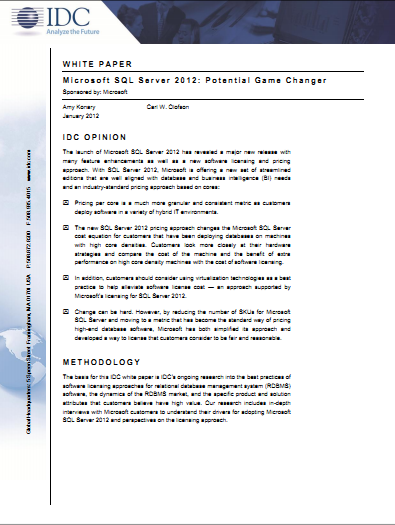
imageThis IDC white paper provides a summary of the new product features of Microsoft SQL Server 2012 as well as the licensing changes that accompany the new release.

This white paper also focuses on the changes to customers’ IT environments – specifically cloud, virtualization, and multicore – that are contributing to shifts in the ways that database software is being deployed and valued.

This white paper provides recommendations for enterprises that are considering adopting Microsoft SQL Server 2012.

Download the report here:
http://download.microsoft.com/download/D/A/E/DAE18CF3-F15E-4670-A81D-EF277440F9EC/IDC_White_Paper_Microsoft_SQL_Server_2012_Potential_Game_Changer_January2012.pdf

Posted by: kurtsh | February 25, 2012

WHITEPAPER: TechNet Magazine–January 2012

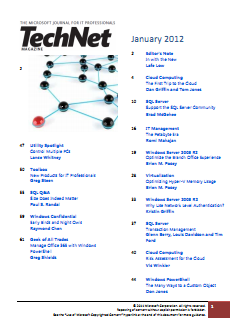
imageThe January edition of TechNet magazine was posted.  As usual, there’s a series of great technical articles on a wide range of topics related to Microsoft technologies.  Here’s the January topics list:

  • Editor’s Note: In with the New by Lafe Low
  • Cloud Computing: The First Trip to the Cloud by Dan Griffin and Tom Jones
  • SQL Server: Support the SQL Server Community by Brad McGehee
  • IT Management: The Petabyte Era by Romi Mahajan
  • Windows Server 2008 R2: Optimize the Branch Office Experience by Brien M. Posey
  • Virtualization: Optimizing Hyper-V Memory Usage by Brian M. Posey
  • Windows Server 2008 R2: Why Use Network Level Authentication? By Kristin Griffin
  • SQL Server: Transaction Management by Glenn Berry, Louis Davidson and Tim Ford
  • Cloud Computing: Risk Assessment for the Cloud by Vic Winkler
  • Windows PowerShell: The Many Ways to a Custom Object by Don Jones
  • Utility Spotlight: Control Multiple PCs by Lance Whitney
  • Toolbox: New Products for IT Professionals by Greg Steen
  • SQL Q&A: Size Does Indeed Matter by Paul S. Randal
  • Windows Confidential: Early Birds and Night Owls by Raymond Chen
  • Geek of all Trades: Manage Office 365 with Windows PowerShell by Greg Shields

ONLINE:  TechNet Magazine: January 2012
http://technet.microsoft.com/en-us/magazine/hh751303.aspx

DOWNLOAD: TechNet Magazine: January 2012
http://download.microsoft.com/download/E/4/C/E4CDC30B-0DE6-494F-B8B0-0A3753A7A64D/January2012.pdf

« Newer Posts - Older Posts »

Categories