Posted by: kurtsh | July 30, 2019

RELEASE: Microsoft Forms Pro

imageForms Pro is a simple, yet comprehensive enterprise survey solution for businesses to capture and analyze feedback to improve how they engage across their business. 

We are excited to announce that effective July 1, 2019, Microsoft Forms Pro will be generally available to Dynamics 365 and Office 365 customers.

Forms Pro will be included with Dynamics 365 Enterprise USLs and as a paid capacity add-on for Dynamics 365 Professional customers. Reference the Dynamics 365 Licensing Guide for details.

imageNEW! Check out our latest white papers to help you learn how to use Microsoft 365 and SharePoint to transform your organizational data, analytics and reporting.

  • Using SharePoint and Teams as a Modern Dashboarding Platform (https://aka.ms/sharepoint/dashboard-wp )
    SharePoint has a long history of providing a first-class platform for business intelligence dashboards based on Power BI, Excel Online, Power BI Report server, and related tools. Adding conversations and other collaborative content brings context to the content and helps to foster a data culture.  SharePoint pages, as well as lists, can be integrated into Microsoft Teams, bringing all this richness to the Teams collaborative environment.  This paper will outline the various approaches to building dashboards in SharePoint, Microsoft Teams and SharePoint Server.
  • Using SharePoint as a data source for Modern Reporting (https://aka.ms/sharepoint/reporting-wp)
    SharePoint is a great organizational data store.  SharePoint lists offer a quick and easy way for users to store and share millions of items, while document libraries have become the industry standard for document management, supplying secure, reliable storage. SharePoint libraries supply the backbone for document storage in all of Office 365. There are several different platforms and technologies for working with SharePoint data, such as Power Query, Excel, Power BI, SQL Server Reporting Services and SQL Server Integration Services.  This white paper examines the different platforms and approaches that can be used to report on SharePoint data and explains the procedures.
  • Using Power BI with Complex SharePoint Field Types (https://aka.ms/sharepoint/datatypes-wp)
    SharePoint lists supply a quick and easy way for users to store and share millions of list-based items.  Text and number fields are straightforward, but complex field types in SharePoint present several challenges.  Power BI provides tools to aid with these challenges, and these tools are the focus of this white paper.
Posted by: kurtsh | July 29, 2019

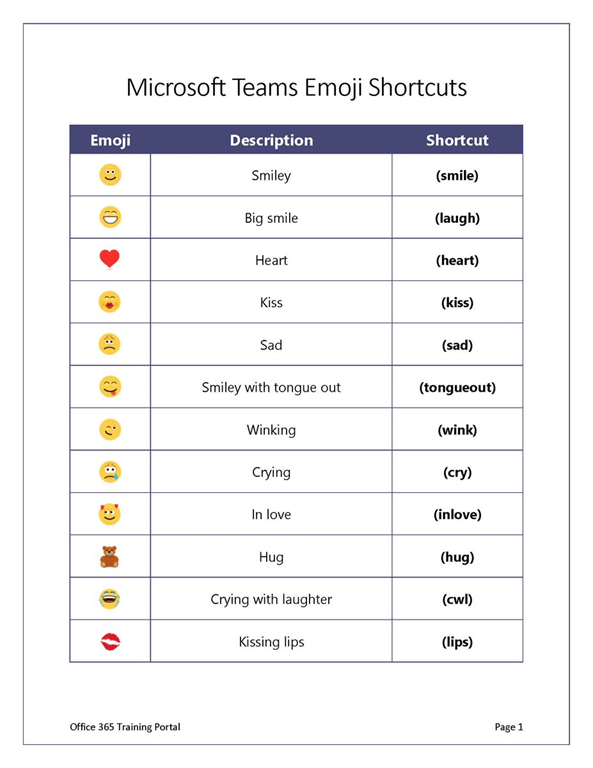
DOWNLOAD: Microsoft Teams Emoji Shortcuts Reference

imageThe folks at Office365 Training Portal have produced a downloadable .PDF that documents all the Emoji that can be posted into Teams discussions using “parentheses notation” such as:

  • (smile)
  • (laugh)
  • (heart)

Get the document for free here:

Posted by: kurtsh | July 29, 2019

INFO: Microsoft 365 guest sharing settings reference

image

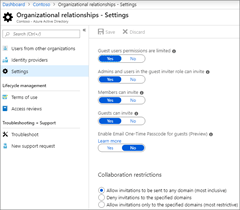
Wanna see all the controls you have around “guest sharing” in Microosft 365?

The link below is a new reference for the various settings that can affect guest sharing for the Microsoft 365 workloads: Teams, Office 365 Groups, SharePoint, and OneDrive. These settings are located in the Azure Active Directory, Microsoft 365, Teams, and SharePoint admin centers.

imageMichael Niehaus, Microsoft Principal Program Manager for Autopilot & Deployment, announced at his blog that he’s going to be doing a public Teams meeting to answer questions about pretty much anything.

If you know who Michael is, you know he’s the preeminent authority on Windows 10 & Office 365 ProPlus deployment & servicing & the primary speaker on these topics at Microsoft Ignite & similar conferences.  If you’ve ever had a Win10/O365ProPlus question that needed answering, this is a great opportunity to ask “the source”.

One of the things that I’ve wanted to do for a while is to have an open Q&A call – you know, the typical “office hours” concept from your college days, where someone says they’ll be available during certain times for any questions you might have.  In my case, I’m not an instructor, and true to the domain name of this site I fully expect to do this from “out of the office” – with any luck, I’ll be sitting at home in my recliner, contemplating what I might want for breakfast before heading into the office.

To cover a broad range of time zones, I’ve picked 8am Pacific Daylight Time (PDT), on Thursday, August 1st.  Here are the connection details:

Join Microsoft Teams Meeting

Conference ID: 330 973 15#

Local numbers

Using the Teams client (locally installed or via the web) is preferred, just in case there is any screen sharing needed, but feel free to call in if that’s easier.

If no one shows up, I’ll chalk this up as a failed experiment and go back to my breakfast.  Otherwise, I’ll look at doing this once a month.

For those with doubts about the time zone math, the zip file below contains an ICS file that you can import to your favorite e-mail client (e.g. Outlook):

Link: August-1-OOFHour.zip

Details below:

imageInterested in the Microsoft Power Platform?

Power Platform Summit North America delivers the can’t-miss annual conference for users of the Microsoft Power platform – Power BI, PowerApps, and Flow. With credible peer-to-peer knowledge exchange at its core, this event provides focused learning and networking as users gain instrumental solutions for their everyday Power platform challenges and larger organizational goals. In every industry and across the globe, Summit is well known as a premier user-centric experience.

At Summit, attendees will have access to:

  • Summit is the only in-person event featuring user-produced education on how to maximize the performance of your software, regardless of version, to further your job role, career, and product investment.
  • Expertise is shared openly and honestly in an authentic community-driven environment that allows you to home in on your region, industry and role—providing the ultimate customized experience that offers return on investment year-round.
  • Network with peers who are in similar roles and face the same issues on a daily basis and receive un-biased support/problem-solving.

Read more here:

image

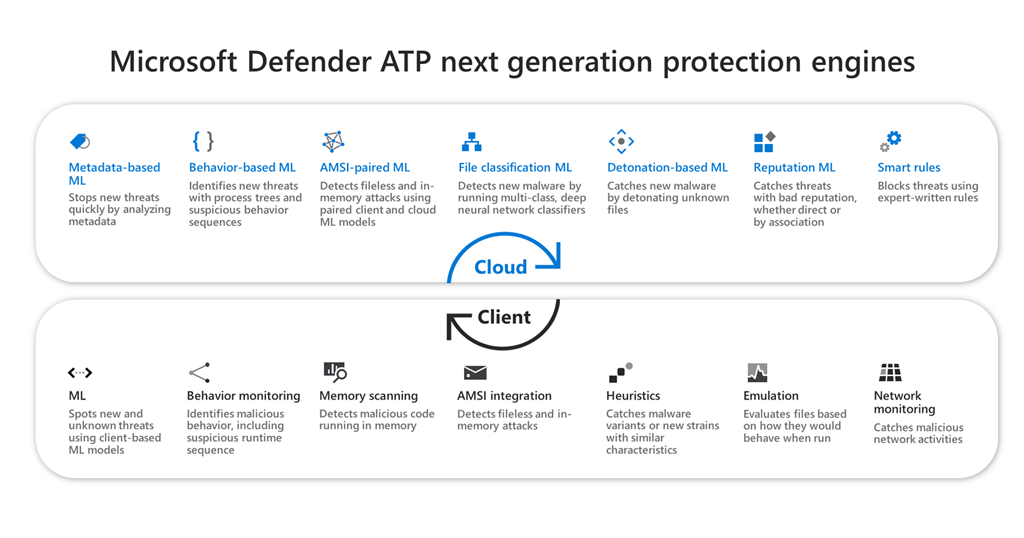
Many of Microsoft Defender ATP’s next-generation protection engines are built into the client and block majority of threats in real-time.

In the cloud, more advanced protections examine new threats on the fly and integrate signals from multiple sources.

Read about each of these technologies here:

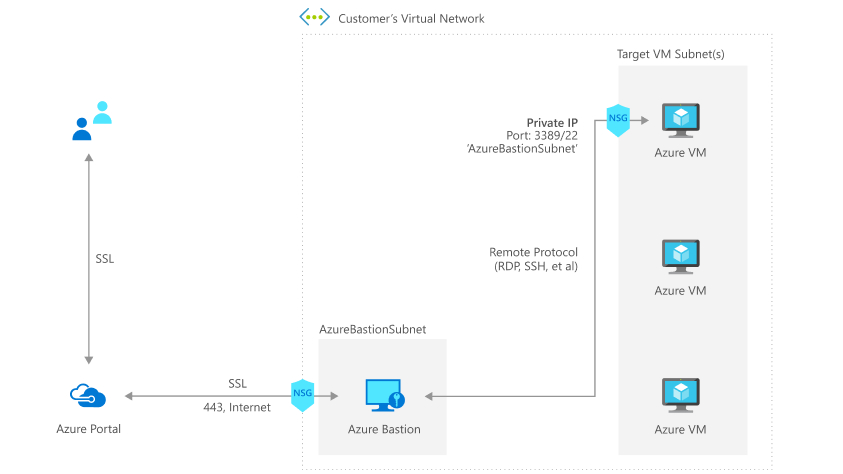
imageRDP/SSH to Azure virtual machines is much simpler and more secure with the new AzureBastion.

Azure Bastion is a new resource that you can deploy in your virtual network. In this video, you’ll learn how seamless and secure RDP/SSH to Azure virtual machines are in the Azure Portal and see how a public IP address on the virtual machines are not needed.

Posted by: kurtsh | July 25, 2019

BETA: Azure Proximity Placement Groups

Cool news for application performance in Azure!

Cimageo-locate your Azure resources for improved application performance

The performance of your applications is central to the success of your IT organization. Application performance can directly impact your ability to increase customer satisfaction and ultimately grow your business.

Many factors can affect the performance of your applications. One of those is network latency which is impacted, among other things, by the physical distance between the virtual machines deployed.

For example, when you place your Microsoft Azure Virtual Machines in a single Azure region, the physical distance between the virtual machines is reduced. Placing them within a single availability zone is another step you can take to deploy your virtual machines closer to each other. However, as the Azure footprint grows, a single availability zone may span multiple physical data centers resulting in network latency that can impact your overall application performance. If a region does not support availability zones or if your application does not use availability zones, the latency between the application tiers may increase as a result.

Today, we are announcing the preview of proximity placement groups. A new capability that we are making available to achieve co-location of your Azure Infrastructure as a Service (IaaS) resources and low network latency among them.

Azure proximity placement groups represent a new logical grouping capability for your Azure Virtual Machines, which in turn is used as a deployment constraint when selecting where to place your virtual machines. In fact, when you assign your virtual machines to a proximity placement group, the virtual machines are placed in the same data center, resulting in lower and deterministic latency for your applications.

Read more here:

imageThe Windows Server team will be having a “Windows Server 2008 End of Support AMA” on July 30th at 9AM PT.

On January 14, 2020, support for Windows Server 2008 and 2008 R2 will end. That means the end of regular security updates. Don’t let your infrastructure and applications go unprotected. We’re here to help you migrate to current versions for greater security, performance and innovation—save the date and bring your questions to the Windows Server 2008 EOS Ask Microsoft Anything" (AMA) event. On Tuesday, July 30, 2019 from 9:00-11:00 a.m. Pacific Time, we’ll have members of the Windows Server Product Team on hand to answer your questions live:

  • Jeff Woolsey, Principal Program Manager
  • Elden Christensen, Principle Program Manager
  • Ned Pyle, Principle Program Manager
  • Rob Hindman, Senior Program Manager

Join us!

« Newer Posts - Older Posts »

Categories