Have you ever been told:

  • “Hey, I tried scheduling an in-person meeting with you but can’t see your calendar to know if you’re in the area & can make it.”
  • “Your calendar has a lot of “Tentative” appointments on it and I can’t tell if there’s any chance of you being able to attend.”

I’m a big proponent of people sharing the full details of their calendar or at least the “title/location” of the appointments on their calendar to help coworkers know if you can actually attend their meetings.

The way to do this is:

  1. Open Outlook & open Calendar
  2. Select “Folder” menu item
  3. Select “Share Calendar” & choose your Microsoft 365 Calendar
  4. Select “My Organization” in “Currently sharing with:” section
  5. Choose either “Can view titles and locations” or “Can view all details” in the “Permissions” section
  6. Click “Ok” to save the changes

Your coworkers should now at least be able to view the title/location details of the appointments your calendar so they know if you’re within driving distance of a meeting or if you can make a meeting even if you’re marked the time as “tentative”.

Notes:

  1. I provide my manager and those I’m closest to with “Can view all details” permissions to my calendar so they can see the details of the meetings I’m having.
  2. I set personal items like doctor’s appointments as “Private” which blocks everyone from seeing the details of the meeting regardless of permissions.
  3. If others can’t see your calendar’s free/busy, much less the appointment contents, see the following article: https://kurtsh.com/2019/01/16/howto-fix-the-problem-where-others-cant-see-your-free-busy-or-calendar-in-outlook/
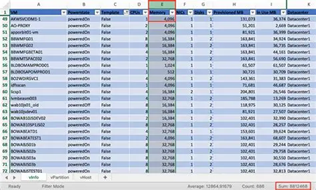
With the recent rise in interest by organizations in migrating from VMware to Azure, I’ve discovered that Azure administrators & many VMware administrators aren’t familiar with “RVTools” & this quick overview may be valuable.

——————-

A valuable component of understanding the VM migration cost to Azure as well as the on-going monthly Azure service costs, is executing an “RVTools” export, a tool owned & managed by Dell.

What is RVTools?
Quoting Dell: “RVTools is a lightweight Windows application that gives VMware administrators instant, detailed insight into their virtual environments. With an intuitive interface and robust export options, it simplifies monitoring, managing, and reporting on virtual machines, clusters, datastores, and more. Designed to save time and drive smarter decisions, RVTools transforms complex data into actionable insights quickly and effortlessly.​”
(Note: RVTools stands for “Rob de Veij Tools”, the creator of the tools which were later acquired by Dell in October 2023.)

What details does RVTools provide?
RVTools exports can provide the following for cost & usage analysis:

  • Virtual machine inventory​: Displays names, power states, templates, and configuration details for all virtual machines.
  • CPU and memory allocation​: Shows the number of CPUs, memory size, and active memory usage for each VM.​
  • Disk and storage details​: Lists the number of virtual disks along with total capacity, provisioned storage, and used storage.
  • Snapshots: Provides presence and detailed data about snapshots to support backup and recovery planning.​
  • VMware tools status​: Highlights the version and running status of VMware tools, ensuring seamless OS integration and management.​
  • Network configuration​: Details NIC count, connected networks, IP addresses, and latency sensitivity.
  • Host and cluster association​: Identifies the ESX host name, cluster name, and resource pool associated with each virtual machine.​
  • Health and configuration flags​: Monitors critical metrics like heartbeat status, consolidation needs, HA settings, and fault tolerance state.​

To read more about RVTools and download the tools themselves, visit:

For guidance on executing the RVTools export for running an Azure assessment, check out the following pages:

A digital experience that is designed to accelerate your AI ambitions, from strategy to secure, scalable execution.

AI is transforming how businesses operate and compete. The Microsoft Cloud and AI Bootcamp has been designed to support business decision-makers, IT professionals and developers who are ready to move from exploration to scalable success. 

Curated by Microsoft experts, the practical sessions are grounded in what’s working now, so you can move forward with clarity and confidence.

  1. Discover what’s working now  – Gain insights from real-world success stories, expert-led demos and partner solutions that show AI in action.
  2. Accelerate AI innovation with an actionable plan  – Discover practical frameworks, architectures and best practices to scale transformative AI solutions using Azure’s latest tools, models and platforms.
  3. Turn data into a strategic asset – Explore ways to unify and prepare your data estate to feed into trusted, high-performing AI systems that drive results.

Explore the agenda below and get ready to witness AI’s extraordinary potential. Don’t miss out. 

Attend this event’s training sessions at no cost to you or your organization. Register for each session individually at:

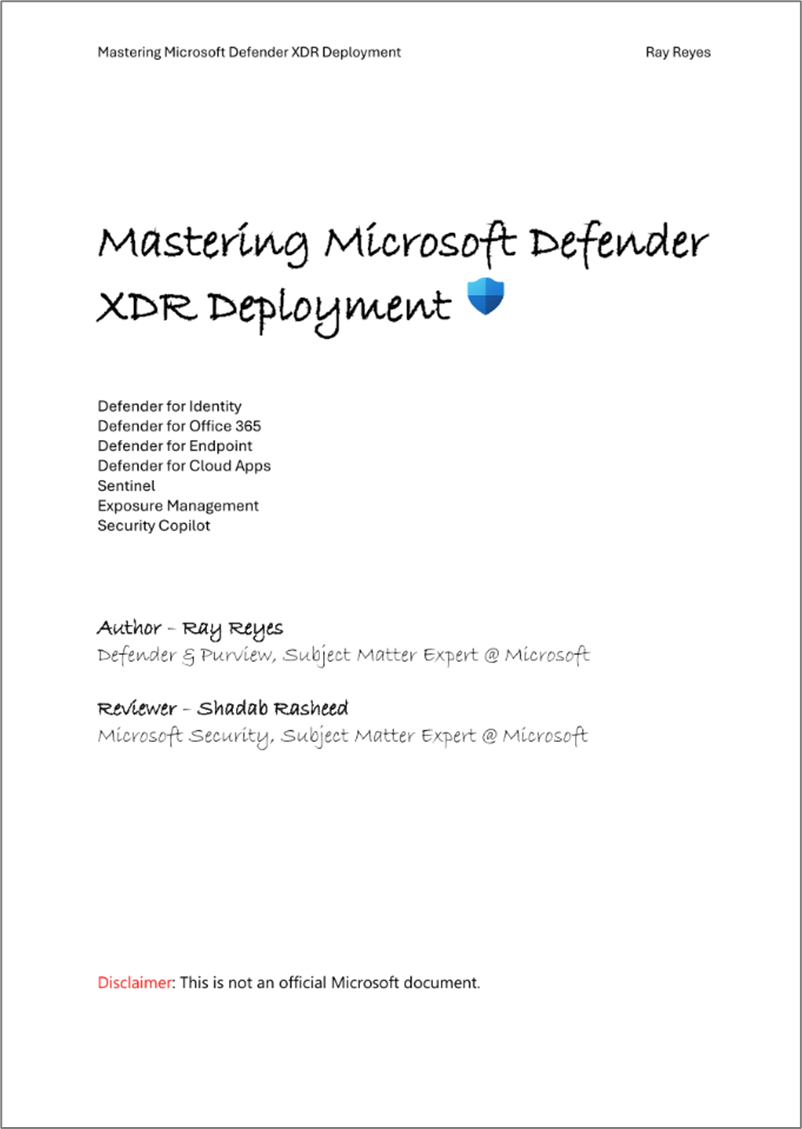
Ray Reyes, published his latest high-level guide to deploying Defender XDR and made it available for all to download, encompassing:

  • Microsoft Defender for Office 365 (MDO)
  • Microsoft Defender for Identity + Microsoft Entra ID Protection = (ITDR)
  • Microsoft Defender for Endpoint (MDE)
  • Microsoft Defender for Cloud Apps (MDA)
  • Microsoft Sentinel
  • Exposure Management

From Ray’s post on LinkedIn:

Here’s the latest version of my Microsoft Defender XDR Deployment guide. It’s been close to a year since I wrote the last version, so lots of new goodies on this guide and newly introduce features. What’s also new is I’ve included a mind map of roles and permission which is always a challenge for new customers.

A story goes a long way to support technical deployments. My role at Microsoft is to help
customers deploy our Defender and Purview products. One of the feedback items I had a while
back from a customer is not knowing ‘why they should’ turn things on, and this guide answers
the WHY. The WHY is what allows customers to re-think and visual what the product is capable
of. I work with customers daily across our Security Solutions, this guide is to help customers
find the easiest path to enabling our overall Microsoft Defender XDR and to answer two
common questions we get in my role.


‘Where do I start? What should I turn on first?

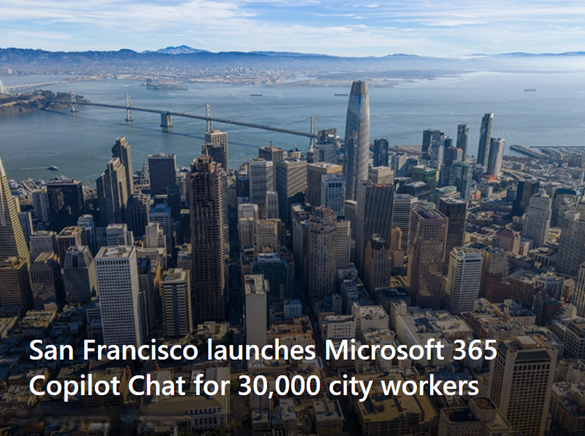
San Francisco is embracing the power of AI with Microsoft 365 Copilot Chat.

  • San Francisco Mayor Daniel Lurie announced that generative artificial intelligence will be available to 30,000 workers across the city government.
  • The city will use Microsoft 365 Copilot Chat, powered by OpenAI’s GPT-4o, for employees like nurses and social workers to improve city services.
  • City hall said the move will make San Francisco one of the world’s largest local governments to leverage AI.

We’re excited by how our work here at Microsoft is helping city workers with basic administrative tasks, giving them more time to respond to residents. Read about their deployment at:

For more information on Microsoft 365 Copilot Chat, visit:

#sanfrancisco #ai #copilot #microsoft #msftadvocate

The Microsoft Unified Enterprise Support Services Description provides information on the support services available for purchase from Microsoft. It is important to familiarize yourself with the descriptions of the services you purchase, including any prerequisites, disclaimers, limitations, and customer responsibilities. The services you purchase will be listed in your Enterprise Services Work Order (Work Order) or another applicable Statement of Services that references and incorporates this document.

The document covers:

  • Customer success and support services
  • How to purchase
  • Flex allowance
  • Description of Microsoft Unified Enterprise Support Services
  • Mission Critical Services
  • Enhanced solutions
  • Unified Multi-Country Program
    • Introduction
    • Program Structure
    • Multi-Country Additional Terms and Conditions
  • Additional terms and conditions
    • Appendix A: Severity Types Charts
    • Appendix B: Success Management Services

Download the document here:

Microsoft has 2 tools for customers to create their own Generative Artificial Intelligence solutions:

  • Microsoft Copilot Studio
  • Azure AI Foundry

Each offers its own value and the following article helps break down what to choose when:

Are you looking to build custom Copilots but unsure about the differences between Copilot Studio and Azure AI Foundry? As a Microsoft Technical Trainer with over a decade of experience, I’ve spent the last 18 months focusing on Azure AI Solutions and Copilot. Through numerous workshops, I’ve seen firsthand how customers benefit from AI solutions beyond Microsoft Copilot.

Microsoft 365 Copilot Chat offers seamless integration with Generative AI for tasks like document creation, content summarization, and insights from M365 solutions such as Email, OneDrive, SharePoint, and Teams. It ensures compliance with organizational security, governance, and privacy policies, making it ideal for immediate AI assistance without customization.

On the other hand, platforms like Copilot Studio and Azure AI Foundry provide greater customization and flexibility, tailoring AI assistance to specific business processes, workflows, and data sources for more relevant support. In this blog, I’ll share insights on building custom copilots, and the tools Microsoft offers to support this journey.

Microsoft Digital on “Copilot Studio or Azure AI Foundry”
Microsoft’s own IT department, “Microsoft Digital” published an article that may also provide some insight on approaching this challenge

  • Customer questions answered: Should I use Copilot Studio or Azure AI Foundry to build my agent?
    When a customer asked us if they should use Microsoft Copilot Studio or Microsoft Azure AI Foundry to build their employee self-service agent, we knew Ravi Goriparthy was exactly the right person to talk to. He and the engineering team he works on here in Microsoft Digital, the company’s IT organization, had to answer that exact question when they set out to build agents that would help our Human Resources and IT Support teams better respond to requests for support from our employees. We had Goriparthy, a principal software engineering manager, talk with our Inside Track bot, which wrote the following story (with some help from us humans).
    https://www.microsoft.com/insidetrack/blog/customer-questions-answered-should-i-use-copilot-studio-or-azure-ai-foundry-to-build-my-agent/?msockid=06377db5fd83631014c06baefce96218

Integrating Copilot Studio with Azure AI Foundry
Additionally, it is possible to integrate both Copilot Studio with Azure AI Foundry’s capabilities in some instances. Watch this video

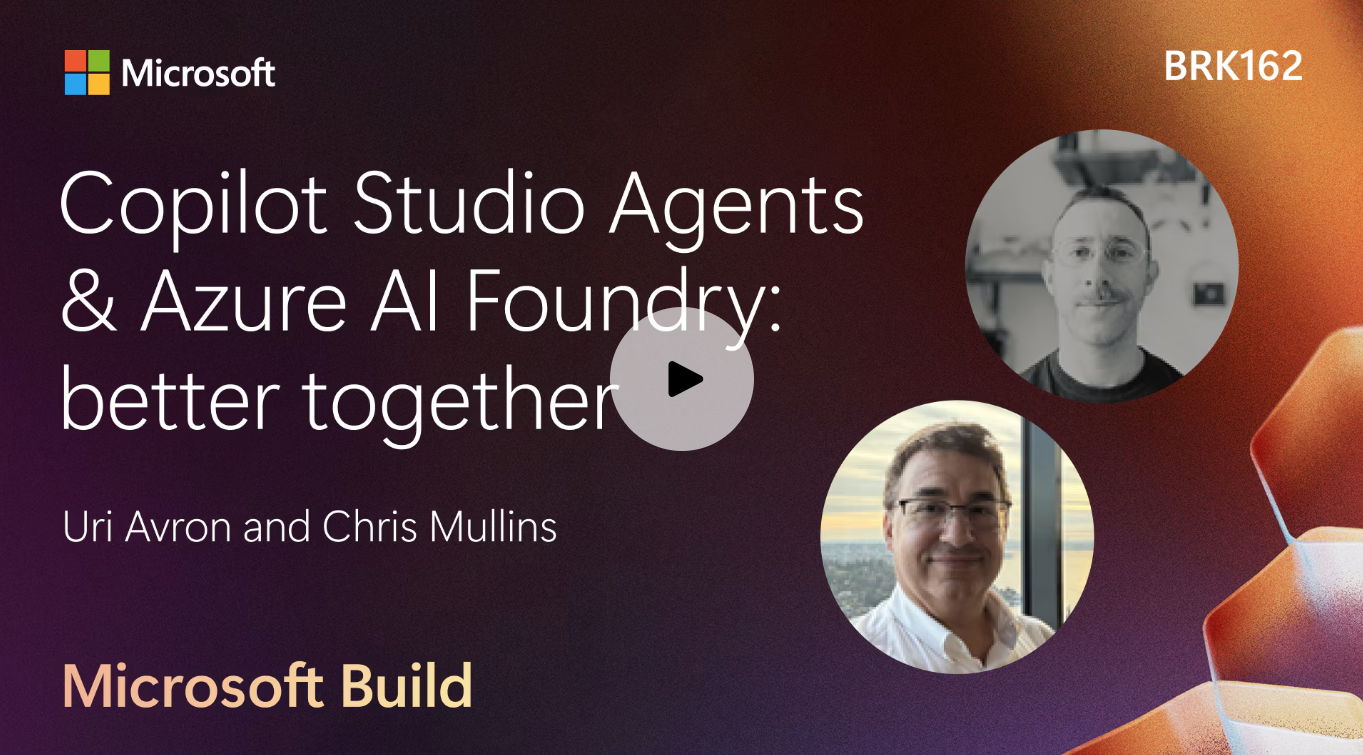
  • Copilot Studio Agents & Azure AI Foundry: better together
    Join us for a session on how to build agents in Copilot Studio with deep integration into Azure AI Foundry services. Learn to leverage your vectorized indices from Azure AI Search to perform RAG and integrate 1800+ models in the Azure model catalog into your Copilot Studio agents.
    https://build.microsoft.com/en-US/sessions/d191c44a-365b-4bfb-bfbf-5bdd9da7bf24

Emily Chang speaks with Microsoft titans Bill Gates, Steve Ballmer and Satya Nadella about the company’s journey from scrappy startup to global powerhouse, and its battle to outpace rivals in the high-stakes AI era.

Dr. Nestori Syynimaa, aka DrAzureAD, is a Principal Identity Security Researcher at Microsoft Security Research. He maintains a notoriously interesting blog for Entra ID Administrators & identity security hawks called “AADInternals – The ultimate Entra ID (Azure AD) / Microsoft 365 hacking and admin toolkit”.

Besides an on-going blog about Entra ID security & management, DrAzureAD goes over tools & techniques for breach that all Entra ID Administrators should know, including:

  • AAD Kill Chain – a collection of recon techniques and hacking tools DrAzureAD discovered and built over the last 10+ years
  • AADInternals & AADInternals-Endpoints PowerShell modules – tools for administering and hacking Entra ID, Office 365, and Entra ID related endpoints. 
  • Links to publicly available Entra ID & Microsoft 365 PowerShell modules, tools
  • OSINT Tenant Information Recon tool – tool will extract openly available information for the given tenant
  • AADInternals Identity Federation Backdoor for GoldenSAML attacks – login to Microsoft 365 tenants using backdoors created with AADInternals
  • Annual presentation recordings & PowerPoints at Defcon, Blackhat, BlueHat, Troopers, Disobey

I’m not going to pretend that I understand even half of what DrAzureAD addresses in his blog except to say that the Doctor comes very highly recommended by our security researchers in Microsoft’s cybersecurity incident response team (CIRT).

Visit AAD Internals at:

Microsoft discontinued the EA and MCA-E Support Plan Promotional Offer on 30 June 2024. This offer provided customers with the aforementioned agreements with Standard support at no additional cost to the customer. Starting 1 July 2024, customers who had support through this offer must purchase a support plan. Customers who already have a separate support plan such as Microsoft Unified are not impacted by this change.

Moving forward, customers continue to have access to Basic support for Azure subscription management and billing. In order to receive technical support for Azure, administrators must either:

  1. Purchase an Azure support plan (Developer, Standard, or Professional)
    or
  2. Contract for a Unified Enterprise plan (which provides technical support for Azure as well as other products & services)

For documentation on the retirement of the EA Promotional Offer for Azure support, visit:

« Newer Posts - Older Posts »

Categories