Posted by: kurtsh | January 4, 2009

OOF: Gone to CES

image I’m out of office… heading to Vegas for CES 2009.

Will post photos here of fascinatingly geeky stuff that I see.  So far admittedly, outside of our (Microsoft’s) impending announcements I’m not seeing or anticipating anything really that stunning but I’ve been wrong before.  In the forums, I’m hearing the same buzz around OLED based displays, Wireless Power, blah blah blah.  Same stuff as last year but we’ll see.

TWITTERING
Have the intention of Twittering at http://twitter.com/kurtsh about the stuff I see.  (We’ll see how long that lasts.)  I figure I’m good for at least day 1 or 2 (8th and 9th of January)

PARTY LIST
And if you find me posting between the hours of 9PM-3AM this week… feel free to shake your head in disapproval the next time you see me, then point to this:  http://www.cespartylist.com/

CESMOBILE
There’s a mobile CES directory available for mobile phones – Windows Mobile included!
http://cesmobile.boopsie.com

image MICROSOFT KEYNOTE
(formerly known as the Bill Gates Keynote – 6:30 p.m. Wednesday, January 7, 2009, The Venetian, Palazzo Ballroom)

I actually don’t know exactly what we’re going to be showing, although I’ve been told a few things from some well placed sources.  One thing’s for sure:  No Bill this year.  It’s Steve from here on out.

I am impressed with the keynote line ups they’ve got this year.

  • Microsoft CEO Steve Ballmer
  • Sony Chairman/CEO Sir Howard Stringer
  • Ford Motors President/CEO Alan Mulally
  • Intel Chairman Craig Barrett
  • Cisco Chairman/CEO John Chambers
Digg This

WinVistaLogo01 I read something on Slashdot today that continues to perpetuate the myth that there if you’ve activated Windows more than twice using the same consumer product activation key, you’re hosed because Microsoft Licensing Services won’t provide another activation for you.

Folks – This is just plain wrong

If you’re an individual user and you find that can’t activate your copy of Windows XP/Vista because you’ve used up your previous activations on your existing consumer product activation key and:

  • You reformatted/reinstalled Windows on your PC
  • You made a hardware change to your machine
  • You upgraded to a new PC

…you can virtually always get another activation through Licensing Services in the US simply by calling the Microsoft Windows Vista Consumer Product Activation Phone Number at 1-866-740-1256.  (Assuming of course that you aren’t abusing the privilege.) 

The entire reason this thing exists is to prevent either piracy by individuals that aren’t aware they’re violating their licensing agreement, or blatant rampant piracy – primarily:

  1. Folks that create new PCs and sell them and never pay for the Windows license on them such as illicit System Builders or mass software piracy operations
  2. Individuals that try to use the same license across many home machines, despite the fact that it is clear that Windows licenses are assigned per machine, and may not be moved from machine to machine.

It’s not there to make your life harder or to “penalize you”.  Just call the phone number, people.

(BTW:  A “consumer product activation key” is an 35-digit activation code that you get on a bright orange label usually inside a commercial copy of Windows XP or Windows Vista that you picked up from a store.)

————————

Other links:

Digg This

Microsoft Commerce Server 2009 December 2008 Community Technology Preview (CTP), formerly known as Commerce Server 2007 code name “Mojave”, is the first feature complete pre-release of the next version of Commerce Server.

We invite you to install this pre-release version of Commerce Server 2009 into a non-production environment to learn more about the Multi-Channel Commerce Foundation, the SharePoint Commerce Services, and the out-of-the-box Default Web site. This release is for evaluation purposes only and is not intended to be used in a production environment. This CTP will not function after June 2009.

What’s New in Commerce Server 2009 December CTP Release?
Commerce Server 2009 delivers the ability to increase your business reach by making it possible to sell via multiple channels using an out-of-the-box shopping site, SharePoint Commerce Services, and the Multi-Channel Commerce Foundation.

The new out-of-the-box shopping site leverages SharePoint Commerce Services, which provides a gallery of ASP.NET 3.5 Web Parts, a comprehensive e-commerce shopping feature-set, and technology integration between Commerce Server and SharePoint technologies. The Multi-Channel Commerce Foundation provides a new unified, extensible run-time programming model for Commerce Server, including new run-time e-commerce capabilities. 

The December CTP adds the following capabilities over previous Commerce Server 2007 code name “Mojave” releases:

  • Update package from Commerce Server 2007, allowing for seamless in-place upgrade of existing deployments. 
  • Complete out-of-the-box e-commerce shopping site in SharePoint with new search functionality, new shopping features, and what-you-see-is-what-you-get (WYSIWYG) content management and design experiences. This helps to facilitate rapid assembly and maintenance of e-commerce Web sites by business users and creative professionals.

December CTP ISO
To download the December CTP ISO, go to the Download Center

Commerce Server 2009 Installation Guide and Readme
To download the Commerce Server 2009 Installation Guide and the Microsoft Commerce Server 2009 December 2008 CTP Readme, click this link

Note: Before you install the pre-release of Commerce Server 2009, you must install the prerequisite software which includes the installation of Commerce Server 2007. Also, you must register with the Microsoft Connect site before you can download the latest readme, additional documentation, or samples. Register on the Microsoft Connect site (
http://go.microsoft.com/fwlink/?LinkID=129508 ) with your Windows Live ID account.

Feedback
Please use the Connect feedback system to provide feedback about the December CTP. 

—————–
source

Posted by: kurtsh | December 30, 2008

DOWNLOAD: Free Microsoft eBook – “Understanding IPv6”

Microsoft Press is releasing the eBook version for “Understanding IPv6” for free to everyone that registers for the download.  Here’s a quick description:

image Writing Secure Code for Vista
by Joseph Davies
ISBN: 9780735624467
Published January 09, 2008

Your essential guide to IPv6—fully updated for Windows Server 2008 and Windows Vista.

Now updated for Windows Server 2008 and Windows Vista, this guide delivers in-depth technical information on Internet Protocol version 6 (IPv6). IPv6 greatly improves on IPv4, the current protocol, by vastly increasing the number of available addresses and by adding enhancements for security, multimedia traffic management, routing, and network configuration. Written by a popular author and networking expert, this reference details the protocol, from its features and benefits to its packet structure and protocol processes. It also describes how to migrate to IPv6-based internetworking, with tips about coexistence with IPv4-based systems, DHCP, DNS, and routing infrastructure. It discusses how IPv6 is supported by the Windows Server 2008 family of operating systems and Windows Vista. Includes companion CD with fully searchable eBook and other references.

REGISTER & DOWNLOAD:
http://csna01.libredigital.com/?urws8un4p7
(Click File-SaveAs to save document to desktop)

Microsoft Press is releasing the eBook version for “Writing Secure Code for Vista” for free to everyone that registers for the download.  Here’s a quick description:

image Writing Secure Code for Vista
by Michael Howard and David LeBlanc
ISBN: 9780735623934
Published April 11, 2007

The definitive guide to developing more-secure software applications for Windows Vista

Get the definitive guide to writing more-secure code for Windows Vista—from the authors of the award-winning Writing Secure Code, Michael Howard and David LeBlanc. This reference is ideal for developers who understand the fundamentals of Windows programming and APIs. It complements Writing Secure Code, examining the delta between Windows XP and Windows Vista security. You get first-hand insights into design decisions, lessons learned from Windows Vista development, and practical advice for solving real-world security issues.

Discover how to:

  • Develop applications to run without administrator privileges
  • Apply best practices for using integrity controls
  • Help protect your applications with ASLR, NX, and SafeSEH
  • Evaluate authentication, authorization, and cryptography enhancements in Windows Vista
  • Write services that restrict privileges and tokens—and sidestep common problems
  • Learn how Windows Internet Explorer 7 defenses and new security features affect your development efforts


    PLUS—Get Microsoft Visual C#, Visual C++, and C code samples on the Web

    REGISTER & DOWNLOAD:
    http://csna01.libredigital.com/?urrs4gt63d
    (Click File-SaveAs to save document to desktop)

    Digg This

  • imageIf you’ve been paying attention there have been 5 distinct major revisions of the Xbox 360 console hardware. (with a 6th on the way in 2009)

    Below are the codenames and the stats for each from oldest to newest:  (The photo to the left is taken from Anandtech. 

    • Xenon (2005-2006)
      Original design – November 2005 (Launch)
      90nm CPU, 90nm GPU, 90nm eDRAM
      Identified by:
    • Zephyr (2006-2007)
      Original Xbox 360 Elite design – May 2007 (Released for Premium design – July 2007)
      90nm CPU, 90nm GPU, & 90nm eDRAM
      With HDMI port
      Improved GPU cooler
      Identified by:
    • Opus (2007)
      Released for Xbox 360 – July 2007
      65nm CPU, 90nm GPU, & 80nm eDRAM
      Improved CPU cooler (Inherited from Falcon)
      Improved GPU cooler (Inherited from Zephyr)
      Identified by:
      • 175W power supply
      • 14,2A next to the 12V line on console’s serial label
      • Does NOT have HDMI port (Available only for Xbox 360 Premium, Core repairs; generally considered rare)
      • Photos at http://www.360drives.com/howto#opus
    • Falcon (2007-2008)
      Released for Xbox 360 Premium & Elite consoles – September 2007
      65nm CPU, 80nm GPU, & 80nm eDRAM
      With HDMI port
      Improved CPU cooler (Different heat sink & cooling duct)
      Identified by:
      • 175W power supply
        (This is indicative of at LEAST owning a Falcon console.  It may be a Jasper.  The only way for the average person to know is to examine the power connector on the console.  See photo above.)
      • 14,2A next to the 12V line on console’s serial label
        (This is indicative of at LEAST owning a Falcon console.  It may be a Jasper.  The only way for the average person to know is to examine the power connector on the console.  See photo above.)
      • Console manufacture date is on or after August 24, 2007
      • Manufacturing lot # is likely to be 0734 or greater
      • Photos at http://www.360drives.com/howto#falcon
    • Jasper (2008-current)
      65nm CPU, 65nm GPU, & 80nm eDRAM
      With HDMI port
      256MB On-board Flash (16MB was standard)
      Identified by:
      • 150W power supply
        (This is an absolute guarantee that the console is a Jasper)
      • 12,1A next to the 12V line on console’s serial label
        (Some Jaspers have been found mislabeled with 14,2A however.  If your console has 14,2A, the only way for the average person to know what motherboard is used is to examine the power connector on the console.  See photo above.)
      • Console manufacture date is on or after October 14, 2008
        (This is not definitive being that there have been Falcons found with a similar manufacture date.  If your console has a manufacture date on 10/14/08, the only way for the average person to know what motherboard is used is to examine the power connector on the console.  See photo above.)
      • Manufacturing lot # is likely to be 0843 or greater
        (This is not definitive as there have been Falcons shipped with the same manufacturing lot.)
      • Photos at http://www.360drives.com/howto#jasper
    • Valhalla (2009? Unreleased/Rumored/etc.)
      Single die CPU & GPU in-one with an unknown trace size – either 65nm or 45nm – with an unknown eDRAM trace size, likely includes an HDMI port and who knows what else.

    WHY SHOULD YOU CARE:
    There’s naturally rational reasons why people have become so infatuated by the science of the Xbox’s parts, chips, drives, motherboard, etc.

    1. RELIABILITY
      The newer the console, the more likely it is to run reliably without issue.  Frankly, this shouldn’t be an issue if you remember rule #1 about owning an Xbox 360.

      Rule #1:  KEEP YOUR XBOX 360 IN A EXTREMELY WELL-VENTILATED AREA

      If you want your console to live a long and healthy life, keep it completely cool.  Seriously.  No exceptions.  This means no confined spaces, no heated rooms, no DVRs or other consoles underneath or on top of the , no walls or blockages near the back of the unit.  Even older consoles – including the original launch Xbox 360 – can run for a very long time. 

      Personally:  I have, not one but TWO original 16,5A 203W power supply-based “Xenon” class Xbox 360 consoles that have run without the Red Ring of Death since the release day of the Xbox 360.  It sits on top of my projection screen 65” TV and it has never, ever, ever locked up.  I once got the “red ring of death” but it was because of a loose connection between my video cable and the console when I moved my TV.


    2. HEAT DISSIPATION
      The newer the console, the less heat it will dissipate due to the smaller chips used.  The smaller the chip, the smaller the silicon traces used, the less electricity used to power the chip, the lower the amount of heat generated by the resistance in the metal.
    3. POWER UTILIZATION
      The newer the console, the less power will be used by each major component of the console.  This is reflected in the smaller power supplies provided by each subsequent generation of the console from 203W to 175W to 150W.
    4. CONSOLE NOISE
      The hotter the unit, the more likely the fan will blow.  The fan can blow loud enough to create a fair amount of noise during game play – particularly during complex, high graphics intensity titles.

      Additionally, the older the unit, the more likely you’ll be using an older Hitachi DVD drive.  The newer Samsung DVD drives are quieter that are available in some units and the BenQ VAD6038 DVD Drive purports to be the quietest drive of them all.

      imageA note on the different DVD Drives in Xbox 360s:

      Yes, it turns out that we varied the manufacturers that built the DVD drives in the Xbox 360.  The early drives were manufactured by Hitachi which were known for being ‘loud’.  Whenever the drive would speed up to read data a loud audible HUMMMM would emit from the Xbox 360.

      At some point later the Toshiba-Samsung drive emerged and was found to be relatively quieter in comparison.  Some people actually went so far as to buy Samsung-TS drives to upgrade their The end result was that there have been at least 3 manufacturer’s drives shipping in Xbox 360’s:

      • Hitachi-LG – Available at launch
      • Toshiba-Samsung – Integrated sometime after launch
      • BenQ VAD6038 – Available as of 11/6/2006
        http://forums.xbox-scene.com/index.php?showtopic=584312
      • Lite-On – Available in 2007, identical to BenQ except with different colored wiring. Appears to be the dominant drive in production today

      More information:

    Basically because each revision has either added new technology over it’s predecessor or it’s gotten cooler and run on less power, it’s preferable to get a newer revision of the console over older revisions considering you’ll be paying the same price regardless of what the technology is inside the Xbox 360 box.

    MORE INFORMATION:
    There’s a lot of information available on the net about this.  Here are some of the better resources that I’ve gleaned over the past year or os.

    1. Anandtech’s Overview of Jasper
      http://www.anandtech.com/gadgets/showdoc.aspx?i=3472
    2. Jasper Motherboard in the Wild: 256MB Internal ‘MU’, 150W PSU
      http://www.xbox-scene.com/xbox1data/sep/EkkZlFAyyZZXEKjatA.php
    3. XBOX.COM:  How to see if you have a 65nm (Falcon) console
      http://forums.xbox.com/ShowPost.aspx?PostID=15804553
    4. XBOX.COM:  How to find a full 65nm Jasper console
      http://forums.xbox.com/24344540/ShowPost.aspx
    5. BenQ VAD6038 – New DVD Drive in Xbox360
      http://forums.xbox-scene.com/index.php?showtopic=584312
    6. IVC Wiki
      http://beta.ivancover.com/wiki/index.php/Xbox_360_Revisions#Zephyr
    Digg This

    <stolen from the Microsoft NAP blog>

    NAP Clients for Linux and Macintosh are available from Avenda and UNETsystem, Inc.

    image Avenda
    The Avenda Linux NAP Agent includes 802.1X enforcement, the Avenda System Health Agent (SHA), and the Avenda Linux NAP Agent System Health Validator (SHV), which you install on your NAP health policy server. For more information, see the Linux Agent tab of the Avenda NAP Agents Web page.

    For the datasheet on the Avenda Linux NAP Agent, click here.

    image UNETsystem
    UNETsystem, Inc. provides both a Linux and Macintosh NAP client.

    • The UNETsystem Linux NAP Client includes 802.1X and DHCP enforcement, the UNET SHA, and the UNET SHV to install on your NAP health policy server. To download it, click here.
    • The UNETsystem Macintosh NAP Client also includes 802.1X and DHCP enforcement, the UNET SHA, and the UNET SHV to install on your NAP health policy server. To download it, click here.

    For more information, see the datasheet available here.

    Download, install, play, and enjoy!

    Digg This

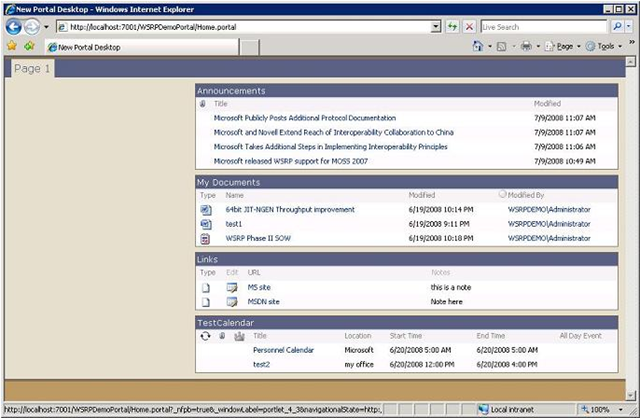
    imageDo you own a Sharepoint Server 2007 installation?

    Do you own IBM Websphere Portal, BEA AquaLogic Portal, or SAP NetWeaver Portal?

    If you’re interested in taking SharePoint data and rendering it natively through your ‘other portal’s’ WSRP consumer portlets, this is the Toolkit for you.

    The Web Services for Remote Portlets (WSRP) Toolkit for SharePoint provides sample code for producing WSRP conformant data from SharePoint lists and libraries.

    The WSRP Toolkit for SharePoint consists of the following assets:

    1. Visual Studio sample projects that demonstrate two different approaches to producing WSRP conformant output from SharePoint lists and libraries
    2. A whitepaper that provides details on the different architectural approaches of the two WSRP producer samples
    3. Screen casts showing the two WSRP producer samples in action

    DOWNLOAD:
    http://code.msdn.microsoft.com/WSRPToolkit

    FOR MORE INFORMATION:
    http://blogs.msdn.com/sharepoint/archive/2008/12/15/announcing-the-wsrp-toolkit-for-sharepoint.aspx

    Digg This

    <taken from the Sharepoint team blog>
    We are happy to announce that December Cumulative Update for Office SharePoint Server 2007 and Windows SharePoint Services 3.0 is available now. Beyond the fixes and improvements, this new update package is also an effort to create a more convenient way for SharePoint administrators to keep all files in their SharePoint installations up-to-date. In this post, we will guide you on how and when to update, and the background of this new update model improvement.

    December Cumulative Update Steps & Suggestions

    [IMPORTANT UPDATE 12/21: Please read the highlighted instructions below before starting your installation.]

    Customers do not need to install these updates unless they are affected by the specific problems described in the KB articles. These cumulative updates will be rolled in to Service Pack 2.

    To keep all the files in a SharePoint installation up-to-date, we recommend that customers install updates in the following sequence:

    1. Windows SharePoint Services 3.0 Service Pack 1
    2. The 2007 Microsoft Office Servers Service Pack 1
    3. December Cumulative Update for Windows SharePoint Services 3.0
    4. December Cumulative Update for Microsoft Office Servers

    After applying the preceding updates, run the SharePoint Products and Technologies Configuration Wizard or “psconfig –cmd upgrade –inplace b2b -wait” in command line. This needs to be done on every server in the farm with SharePoint installed.  The version of content databases should be 12.0.0.6335 after successfully applying these updates.

    For more in-depth guidance for the update process, we recommend that customers refer to the following articles. These articles provide a correct way to deploy updates, identify known issues (and resolutions), and provide information about creating slipstream builds.

    The detail of December Cumulative Update (CU) for Office SharePoint Server 2007 and Windows SharePoint Services 3.0 can be found here:

    MORE INFORMATION:
    http://blogs.msdn.com/sharepoint/archive/2008/12/17/announcing-december-cumulative-update-for-office-sharepoint-server-2007-and-windows-sharepoint-services-3-0.aspx

    Digg This

    Powershell2 <as taken from the Microsoft Clustering blog>

    In Windows Server 2008 R2 (“R2”) we are introducing PowerShell as the new scripting language for clustering technologies. PowerShell with Failover Clustering will replace Cluster.exe and the Windows Server 2008 R2 release will be the deprecation release for Cluster.exe. This means it will still available for use so it doesn’t break legacy scripts, but no improvements have been made and Cluster.exe will be completely removed in the next release of Windows Server. This allows ample time for you to learn (and love) PowerShell.

    PowerShell provides numerous benefits over standard command line interfaces, including easily customizable scripts and the dynamic use of variables. In Windows Server 2008 R2, PowerShell can also be run on Server Core machines. Using PowerShell on a Core cluster, you can directly run cluster Validation and generate dependency reports, without needing to manage the Core node through a UI-based remote machine.

    This blog post will provide an overview of PowerShell with Failover Clustering. In the next few weeks, a post about PowerShell with Network Load Balancing (NLB) will be added to the site.

    How do I get R2 Beta?

    There are numerous ways to get the Windows Server 2008 R2 Beta build which includes Failover Clustering (on Enterprise and Datacenter editions). If you work for an organization which partners with Microsoft, try contacting your Technology Account Manager (TAM) to see if they can provide you with access. If your organization is enrolled in the Technology Adoption Program (TAP) you may also have access through this channel. Others may enroll in the Microsoft Connect program (http://connect.microsoft.com/) to receive access to major builds. The Beta build will be available very shortly for deployment and testing.

    We want your feedback!

    PowerShell is going to be the cluster scripting language for the future – and you have the opportunity to influence its design and use for the next decade during the Beta feedback period. Some high-level areas of feedback for the PowerShell commands (cmdlets) which we are looking for include the following:

    • Was it easy to find the cmdlet you wanted?
    • Are the parameters consistent between cmdlets?
    • Is the in-box help and example useful?
    • Has the PowerShell utility met your scripting needs?
    • Was there a cmdlet which did something different than you expected from its name or description?
    • Anything else?

    We encourage you to provide feedback through the appropriate channels on the Microsoft Connect site, through your TAM, or TAP Program Manager.

    ———————

    MORE INFORMATION:
    http://blogs.msdn.com/clustering/archive/2008/12/20/9243367.aspx

    Digg This

    « Newer Posts - Older Posts »

    Categories