bingLogo_lg_3 Microsoft Corp. yesterday unveiled Bing, a new Decision Engine and consumer brand, providing customers with a first step in moving beyond search to help make faster, more informed decisions. Bing is specifically designed to build on the benefits of today’s search engines but begins to move beyond this experience with a new approach to user experience and intuitive tools to help customers make better decisions, focusing initially on four key vertical areas: making a purchase decision, planning a trip, researching a health condition or finding a local business.

The result of this new approach is an important beginning for a new and more powerful kind of search service, which Microsoft is calling a Decision Engine, designed to empower people to gain insight and knowledge from the Web, moving more quickly to important decisions. The new service, located at http://www.Bing.com, will begin to roll out over the coming days and will be fully deployed worldwide on Wednesday, June 3.

The new service, located at http://www.Bing.com, will roll out over the coming days and will be deployed worldwide on Wed., June 3, 2009.

For more information visit the following links:

Digg This

image The download below includes updated Group Policy Administrative Template files and Office Customization Tool OPA files for use with the 2007 Microsoft Office system applications. It also includes an Admin folder with an updated Office Customization Tool, and ADMX, ADML, and ADM versions of the 2007 Microsoft Office system Administrative Template files for Windows Vista and Windows Server 2008.

For Administrative Template files, you may use the ADM files for any Windows operating system, or the combination of ADMX and language-specific ADML files on computers running at least Windows Vista or Windows Server 2008. This download also includes a workbook (Office2007GroupPolicyAndOCTSettings.xls) that provides information about the 2007 Office system Group Policy settings and OPA settings. This update assumes that you have updated your 2007 Office System applications with the 2007 Office System Service Pack 2 (SP2).

For more information about this download, see 2007 Office system Administrative Template files (ADM, ADMX, ADML) and Office Customization Tool updates.

For more information about ADMX and ADML files, see Managing Group Policy ADMX Files Step-by-Step Guide on the Microsoft TechNet Web site.

Digg This

image This is a summation of the NEW and IMPROVED features in Active Directory in Windows Server 2008 that a coworker produced on the east coast.

This is a two page quick reference document that some of you AD admins will find interesting to learn from.

Enjoy!

http://cid-00da410c7f7e038d.skydrive.live.com/embedrowdetail.aspx/ProductMaterial/WindowsServer2008/WindowsServer2008SummaryofActiveDirectoryImprovementsv6Final.pdf

(Download here.)

Digg This

image What’s in your phone that you can’t replace?  New numbers for old friends, photos of kids vacation memories?  Isn’t not just for calls and email… your phone lives with you.

Statistics say you should back it up.
Did you know that an estimated 12 million mobile devices are lost or stolen every year in the United States?*  Microsoft My Phone is a free** service that lets you confidently sync your phone to the Web, helping to keep your information protected even if you lose your phone.

Keep more and do more.
– Back up and restore your phone’s information with confidence.
– Access your text messages and make updates to your contacts and appointments from any computer.
– Share your photos with family and friends

Here’s a few important facts:

  • 200MB of free storage
  • Automatic backup each night (between 11PM-5AM)
  • Beta only open to Windows Mobile 6 devices currently
  • Backs up contacts, calendar appointments, tasks, photos, videos, text messages, music, and documents
  • Provides access to backed up content online
  • FREE!

HELP PROTECT YOUR INFORMATION.  USE MY PHONE TODAY!

* IDC Blackbook, Strategy Analytics, MCS Research
** Data charges may apply

Digg This

image_thumb_1 Saw this on the Ask the DS Team blog and I know there are a bunch of you out there that have encountered this.

Howdy folks, Scott Goad again to talk about an issue that I thought you might find useful.

I recently worked with a customer who opened a case for an intermittent profile issue. Windows XP workstations would not load the local profile, resulting in the user receiving a temporary profile. The issue seemed to happen when a user logged off and then needed to log back into the workstation, resulting in the temporary profile.

We started the usual troubleshooting steps for working on this type of profile load problems. We enabled USERENV debug logging (more on that here). The customer readily enabled the logging and proceeded to reproduce the issue. They were able to gather a problematic log along with a saved copy of MSINFO32, which grabs the processes running and their associated Process ID. This is useful to identify what process is running, which is recorded in the USERENV log. The USERENV log did show a problem:

The short version is that the inability to open a user’s profile (resulting in the creation of a temporary profile and a slow logon) may be due to the usage of Citrix ICA client and a sharing violation that it can cause.

Read more at:
http://blogs.technet.com/askds/archive/2009/05/21/temporary-user-profiles-and-the-citrix-ica-client.aspx

Digg This

This is pretty sweet.  I’m going to assume you already know what a Microsoft Tag is.  If you don’t look into it here:

WHAT’S A CUSTOM TAG?
Basically a custom tag is simply a normal tag that’s disguised using normal pictures and photos.  So instead of a Microsoft Tag that you associate with your web site or contact info that looks like this:

image 
A typical Microsoft Tag

You can have a Microsoft “custom” Tag that looks like this:

image

Here’s the video tutorial on how to accomplish this using Powerpoint:

http://vimeo.com/moogaloop.swf?clip_id=4378441&server=vimeo.com&show_title=1&show_byline=1&show_portrait=0&color=&fullscreen=1

For more information, go to:
http://blogs.msdn.com/tag/archive/2009/05/18/creating-a-custom-tag-for-the-tag-slaps-design-contest.aspx

Creating Custom Tags from Elliott Lemenager on Vimeo.

Digg This

image Y’know, I’ve had this issue with my wife several times when I’m travelling on business.  Windows Live Messenger won’t always establish a video camera conversation so we’ll have to switch to Office Communicator instead.

(The following was blatantly stolen from the Windows Live Messenger Support page at:
http://messenger-support.spaces.live.com/Blog/cns!8B3F39C76A8B853F!15235.entry)

——————————-

If you are having difficulty establishing a video conversation with a contact in Windows Live Messenger, please try the following:

1. Make sure that your webcam device is configured properly with Windows Live Messenger by running the Audio and Video Setup…

1.a.  Start Windows Live Messenger. 
1.b.  Press Alt on the keyboard. Click Tools, then click Audio and Video Setup.
1.c.  Follow the directions in the wizard to select and configure the audio and video devices. 

If you encounter an error and you have a McAfee Site Advisor, please refer to our related article: http://messenger-support.spaces.live.com/blog/cns!8B3F39C76A8B853F!14323.entry

2. Disable the QoS Packet Scheduler

2.1  For Windows XP:
2.1.a.  Click Start, and then click Control Panel. 
2.1.b.  Click Network and Internet connections, and then click Network Connections. 
2.1.c.  Under LAN or High-Speed Internet, select the Local Area Connection that has a status of Connected. 
2.1.d.  Right-click that connection and then click Properties. 
2.1.e.  Clear the QoS Packet Scheduler check box. 
2.1.f.  Click OK to save the changes and close the window. 

2.2  For Windows Vista:
2.2.a.  Click Start Pearl, type Network and Sharing Center in the Start Search box, and then press ENTER. 
2.2.b.  Click Manage network connections. 
2.2.c.  Under LAN or High-Speed Internet, select the Local Area Connection that has a status of Connected. 
2.2.d.  Right-click that connection, and then click Properties. 
2.2.e.  Clear the QoS Packet Scheduler check box. 
2.2.f.  Click OK to save the changes and close the window.

3. Remove Third Party Applications

Look for any of the following: MyWebSearch Toolbar, Smiley Central, Messenger Plus, Kiwee Toolbar, Info Pen or MacroGaming SweetIM installed in your computer. These might be integrated with the Messenger but are actually third party add-ons which Microsoft did not author nor test and have been observed to cause conflicts with the Messenger program. If you have them installed, uninstall them.

3.1Windows Vista:
3.1.a. Click Start, type Control Appwiz.cpl in the Start Search box, and then press ENTER.

3.1.b. In the list of installed programs, search for any third-party toolbars, such as MyWebSearch Toolbar, Smiley Central, Messenger Plus, Kiwee Toolbar, Info Pen or MacroGaming SweetIM and then uninstall the program. 

3.1.c. Restart the computer. 

3.2Windows XP
3.2.a. Click Start, click Run, type Control Appwiz.cpl in the Open box, and then press ENTER to open the Add or Remove Programs item. 

3.2.b.  In the list of installed programs, search for any third-party toolbars, such as MyWebSearch Toolbar, Smiley Central, Messenger Plus, Kiwee Toolbar, Info Pen or MacroGaming SweetIM and then uninstall the program. 

3.2.c.  Restart the computer. 

4. Disable Internet Protocol security (IPSec):

4.1 Windows Vista:
4.1.a.  Click Start , and then click Control Panel. 
4.1.b.  Click System and Maintenance, and then click Administrative Tools. 
4.1.c.  Double-click Services. If you are prompted for an administrator password or for a confirmation, type the password, or click Continue. 
4.1.d.  Right-click IPsec Policy Agent, and then click Stop to stop the IPSec service. 
4.1.e.  If stopping the IPSec service does not resolve the issue, restart the IPSec service. To restart the IPSec service, right-click IPsec Policy Agent, and then click Start. 

4.2 Windows XP:
4.2a.  Click Start, and then click Control Panel. 
4.2.b.  Click Performance and Maintenance, and then click Administrative Tools. 
4.2.c.  Double-click Services. 
4.2.d.  Right-click IPSEC, and then click Stop to stop the IPSec service. 
4.2.e.  If stopping the IPSec service does not resolve the issue, restart the IPSec service. To restart the IPSec service, right-click IPSEC, and then click Start. 

Digg This

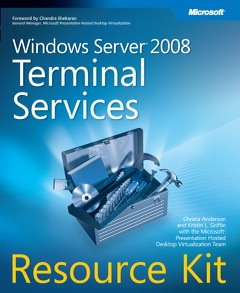
9780735625853Here we go again!  Another completely free eBook from MS Press: 

Windows Server 2008 Terminal Services Resource Kit
By Christa Anderson and Kristin L Griffin with the Microsoft Presentation Hosted Desktop Virtualization Team
ISBN: 9780735625853

Your definitive resource for deployment and operations—straight from the experts.

In-depth and comprehensive, this Resource Kit delivers the information you need to set up, deploy, and manage a Terminal Services farm using Windows Server® 2008. You get authoritative technical insights from Terminal Services experts, including guidance from members of the Microsoft® product team—along with essential scripts and resources on CD.

Get expert advice on how to:

  • Install and configure role services, and learn how they support business cases
  • Apply best practices for securing terminal servers and authorizing executables
  • Use Group Policy to configure a terminal server environment
  • Redirect devices effectively to make a remote experience feel local
  • Install and publish applications with TS RemoteApps programs and TS Web Access
  • Create a secure, fault-tolerant WAN access solution using TS Gateway
  • Manage terminal servers and user sessions with command-line and graphical tools
  • Keep server roles available and restorable through change management, including virtualization approaches

DOWNLOAD:
http://csna01.libredigital.com/?urws8un4p7

Digg This

Posted by: kurtsh | May 28, 2009

NEWS: Operations Manager 2007 R2 hits RTM

image Late yesterday the RTM of Operations Manager 2007 R2 was approved, which immediately initiated the next stage of the process … getting this latest version of Microsoft’s end-to-end monitoring product for IT environments and datacenters out to YOU!  Read more in our overview whitepaper, What’s New datasheet, or download the trial, and see customer stories and more information on our pages on Microsoft.com and TechNet.

The trial version of Operations Manager 2007 R2 RTM (build 7221) is now available via the Microsoft Download Center.  General Availability of the product will be 1st July 2009, at which point new and existing customers will be able to obtain the bits from their respective customer download centers, such as MVLS.

Read more about:

  • Newly released datasheets & collatoral
  • Overview whitepaper
  • “What’s New” whitepaper
  • Technet Online Virtual Labs
  • Technet Webcasts on Ops Manager 2007 R2
  • Technet EDGE video blogs about Ops Manager 2007 R2
  • Extensions for Ops Manager 2007 R2 including
    • Interoperability Connectors
    • Visio Add-in
    • Exchange 2007 Management Pack
    • etc.

MORE INFO:
http://blogs.technet.com/systemcenter/archive/2009/05/22/om2007r2-rtm.aspx

Digg This

image Did you ever wonder… gee, I hope my notifications are working as configured.  Otherwise, if my notifications aren’t working as I think they are, I’ll never receive an email/text message/instant message and I’ll never know when a server goes down.

Worry no longer.  Introducing the Notification Test Tool.

The Notifications Test Tool is a simple tool you can use to test your notification channels and subscriptions. This tool can be used to test email (SMTP), Instant Message (IM) or Text message (SMS) channels. Also, you can use this to generate a test alert in OpsMgr to test subscriptions.

[taken from the SCOM blog]

Install Instructions:
Download and install the OMTestTool.msi to a local directory on your computer.

Note: This tool must be installed on a computer that has the OpsMgr console installed and run from someone logged as a local admin. To run the tool you must me a member of the OpsMgr Administrator group.

I have included a small user guide in the zip file.  This tool will work on all version of OpsMgr.  I plan to update this tool to support multiple channels types that R2 now exposes when I get some time.

Note: If you are running this tool on an OS where UAC is enabled please make sure to right click and run as Administrator.

DOWNLOAD:
http://blogs.technet.com/momteam/attachment/3243276.ashx

Digg This

« Newer Posts - Older Posts »

Categories