Join us for this two-day event to learn about the essential guidance, resources, products and tooling you need to accelerate your next Azure and AI project or enhance your existing Azure deployments.

Get in-depth technical guidance from Microsoft experts to enhance the reliability, security and ongoing performance of your Azure workloads. Learn more about AMD products and solutions to accelerate cloud adoption.

Agenda as follows:

Tuesday, February 11, 2025

Wednesday, February 12, 2025

Be sure to register below to receive event reminders and exclusive post-event content, including access to session presentations.

Date/Time:

  • Feb 11, 2025 7:30 AM – Feb 12, 2025 10:30 AM PST

Registration:
Posted by: kurtsh | February 2, 2025

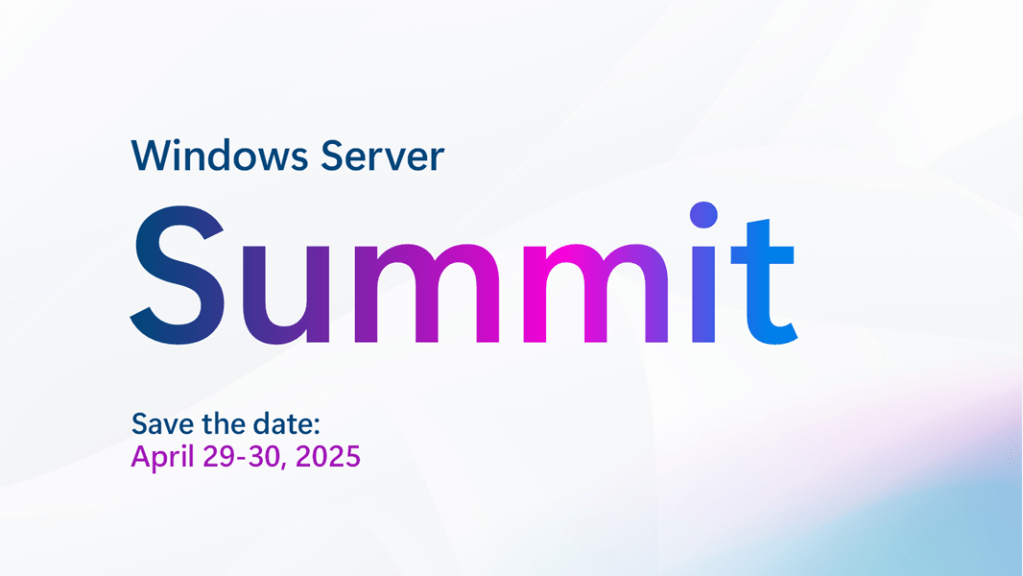
EVENT: Windows Server Summit 2025 – April 29-30, 2025

Save the date! On April 29-30th we are kicking off our annual Windows Server Summit virtual event, featuring demos, technical sessions, and live Q&A, led by Microsoft engineers. The event will be hosted on Microsoft Tech Community and will feature deep-dive sessions on:

  • Windows Server 2025 upgrades and implementation
  • Best practices for security and identity
  • What you can do with Windows Server on Azure
  • Hybrid cloud management and technologies like Azure Arc
  • New features, including a sneak peek at what’s coming next in preview
  • and much more! 

All sessions will be streamed live here on the Tech Community and experts will be answering your questions live. We are still fine-tuning the agenda, but plan to reveal the full lineup on February 18, 2025.

Date:

  • Windows Server Summit 2025
    April 29-30, 2025

Registration Page:

Looking to get started using “Microsoft 365 Copilot” or “Microsoft 365 Copilot Chat” but don’t know where to begin?

Cheat Sheet: “Microsoft 365 Copilot”
Here’s a cheat sheet of prompts that are designed to work in Microsoft 365 Copilot with your work data: (Microsoft 365 Copilot is AI that natively provides responses within Microsoft 365 Apps like Word, Outlook, Teams, etc. & is based on work data you have access to such as your Exchange Online inbox, OneDrive account, Teams & SharePoint Online)

  1. “What’s the latest on this issue…”
  2. “What’s the latest from this person…”
  3. “Recap this meeting…” 
  4. “What’s hot in my inbox?”
  5. “Help me prepare for this meeting…”
  6. “Create an FAQ based on…”
  7. “Create a presentation from this doc…”
  8. “Analyze this data…”
  9. “Summarize the Teams messages where I mentioned”
  10. “Summarize messages from my boss this week.”
  11. “Rewrite this …”
  12. “Draft a marketing brief based on this document…”
  13. “What’s on my calendar tomorrow?”
  14. “What are my next three customer meetings?”
  15. “Give me a summary of the recent news from…”
  16. “Draft an update to my team based on this document…”
  17. “Draft a proposal using this document as a template and this doc for the details…”
  18. “Summarize this email thread…”
  19. “What action items do I have from this meeting?”
  20. “Summarize this presentation…”
  21. “Analyze the sentiment of this data…”
  22. “Add a column to this spreadsheet…”
  23. “Create a line chart using this data…”
  24. “What does this document say about…”
  25. “How much time have I spent on this over the last week…”
  26. “Find a time when I can meet with…”

Cheat Sheet: “Copilot Chat”
What if you don’t yet have a subscription license for “Microsoft 365 Copilot” but do you have “Microsoft 365 Copilot Chat“? (Copilot Chat is a no-cost Copilot for Microsoft 365/Entra ID licensed users that provides responses based on web-based information & files directly submitted to it but does not directly access, index or distill work data in Exchange Online, OneDrive, SharePoint or Teams)

Here’s a cheat sheet of prompts for Copilot Chat to get you started:

  1. “Summarize this document for me…” with uploaded document
  2. “What does this document say about…” with uploaded document
  3. “What can you tell me about…”
  4. “Help me write…”
  5. “Help me rewrite…”
  6. “Help me brainstorm…”
  7. “Help me diagnose what’s happening with…”
  8. “Help me think through the pros and cons of…”
  9. “How would you approach…”
  10. “Create a graph…” with uploaded spreadsheet.
  11. “Give me step-by-step instructions for…”
  12. “Explain…”
  13. “Get me up to speed on…”
  14. “Compare this to that…”
  15. “Compare this file to that file…”
  16. “Create an image…”
  17. “Translate…”
  18. “Write the code to…”
  19. “Convert this to that…”
  20. “Give me some tips for…”
  21. “Help me express this differently…”
  22. “Remind me how this works…” for mathematical concepts
  23. “Remind me how this works…” for scientific concepts
  24. “Remind me how this works…” for business concepts
  25. “How do I…” for technology tasks

References:

Microsoft is excited to participate once again in Enterprise Connect, the leading conference and exhibition for enterprise communications and collaboration in North America.

‌Taking place March 17-20, 2025, Enterprise Connect attracts IT decision makers, partners and analysts to learn from industry thought leaders about strategies for planning and implementing communications and collaboration and contact center solutions. 

‌We are delighted to be the first vendor keynote of the event and we will participate across several panels. 

(Click here to view the full schedule and session line-up.)

Registration:

Did you know you get unlimited virtualization through Azure Hybrid Benefit for SQL Server in an Azure VMware Solution private cloud?

This is accomplished by establishing a “Placement policy”. (Note: This is technically a required step for licensing compliance with Azure Hybrid Use Benefit policy.)

Here are 3 simple steps to enable & configure the required “Placement Policy” for SQL servers on Azure VMware Solution clusters from the Azure administrative portal:

  1. Select Azure Hybrid Benefit > Create VM-Host affinity placement policy
  2. Fill in the required fields for creating the placement policy
    (Name, Type, AHUB acknowledgement, Cluster, Enable Policy?)
  3. Select the hosts and VMs to be applied to the VM-Host affinity policy
    (Select hosts, Select VMs, Review & Create)

The following video walks you through the process of establishing the aforementioned Placement policy:

For written steps on how to complete this, visit:

·

If you have marketing, communications or sales departments that are using Exchange Online to “email blast” messages out to more than 2,000 recipients a day, you need to read the following:

In April 2024, we announced that Exchange Online would begin enforcing an external recipient rate limit (ERRL) of 2,000 recipients in 24 hours. This will begin in October 2025 at the earliest. (MC787382 – Exchange Online to introduce External Recipient Rate Limit)

Exchange Online currently enforces a Recipient Rate limit of 10,000 recipients. The 2,000 External Recipient Rate Limit (ERRL) will become a sub-limit within this 10,000 Recipient Rate limit. There is no change to the Recipient Rate limit, and both of these will be rolling limits for 24-hour windows. You can send to up to 2,000 external recipients in a 24-hour period, and if you max out the external recipient rate limit then you will still be able to send to up to 8,000 internal recipients in that same period. If you don’t send to any external recipients in a 24-hour period, you can send to up to 10,000 internal recipients.

This new limit is not going to be applicable to the following Microsoft integrations until further notice:

How will this change happen?
The new “External Recipient Rate limit” will be introduced in 2 phases:

  • Phase 1 – October 2025, the limit will apply to cloud-hosted mailboxes of trial tenants and all cloud-hosted mailboxes of tenants created after that date. This phase will include an Exchange Admin Center mail flow report detailing the External Recipient count of cloud-hosted mailboxes belonging to the tenant.
  • Phase 2 – April 2026, we will start applying the limit to cloud-hosted mailboxes of existing tenants.

Please refer to the ACS email documentation (Prepare an email communication resource for Azure Communication Services – An Azure Communication Services concept article | Microsoft Learn) or reach out to your Microsoft account team for further support in this journey.

What are the options for customers who have business needs that exceed the ERR limit?
If you have a cloud-hosted mailbox that needs to exceed the ERR limit, you can move to Azure Communication Services for Email, which is designed specifically for high volume email sent to recipients external to your tenant.

Is this limit counted against per recipient or per unique recipient?
We will be counting per recipient not per unique recipient. So, if you sent 100 emails to the same 5 external recipients, it would count as 500 external recipients.

Read more about this & remediation steps here:

(Note: This change only applies to Microsoft 365 Commercial instances. The rate limit will be applied to GCC instances in the future however at the moment, they are exempt.)

Beginning on Jan 27th, 2025, any OneDrive user accounts in Microsoft 365 COMMERCIAL cloud instances that have been unlicensed for longer than 93 days will be inaccessible to admins & end users.

  • For example, if a OneDrive account became unlicensed on August 1st, 2025, this account will be inaccessible as of Oct 1st, 2025.

Accounts become unlicensed when the admin removes the license, or the user is deleted from Entra ID. These accounts will be automatically archived and will still be viewable via admin tools but will not be accessible until admins take action on them through the following:

  1. Setting up the Archive billing for unlicensed accounts to be able to access and edit the archived files.
  2. Optionally re-license the unlicensed account to maintain access.

All Purview features will work with archived, unlicensed OneDrive accounts including retention policies, legal holds, and eDiscovery search & export, however to access the data that is eDiscovered or legally held, you MUST establish Microsoft 365 Archive billing or the content will not be extractable or downloadable.

To learn how to establish Archive billing, read more about this change below:

(Note: This will apply to Microsoft 365 GCC/Government cloud instances in the future however a specific date is not set yet.)

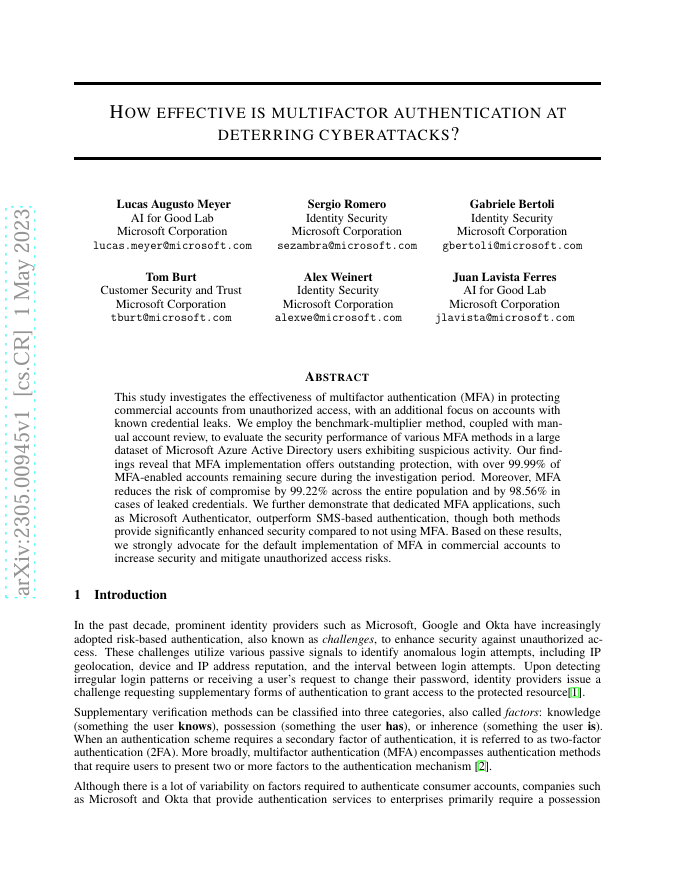
We have a .PDF whitepaper that is downloadable from Microsoft Research that goes over the efficacy of MFA.

This study investigates the effectiveness of multifactor authentication (MFA) in protecting commercial accounts from unauthorized access, with an additional focus on accounts with known credential leaks. We employ the benchmark-multiplier method, coupled with manual account review, to evaluate the security performance of various MFA methods in a large dataset of Microsoft Azure Active Directory users exhibiting suspicious activity.

Our findings reveal that MFA implementation offers outstanding protection, with over 99.99% of MFA-enabled accounts remaining secure during the investigation period. Moreover, MFA reduces the risk of compromise by 99.22% across the entire population and by 98.56% in cases of leaked credentials. We further demonstrate that dedicated MFA applications, such as Microsoft Authenticator, outperform SMS-based authentication, though both methods provide significantly enhanced security compared to not using MFA. Based on these results, we strongly advocate for the default implementation of MFA in commercial accounts to increase security and mitigate unauthorized access risks.

Download the whitepaper here: (Click the PDF link on the left)

Copilot for Microsoft Teams has a feature called “Intelligent Recap” which provides:

  • AI-generated text summaries of Teams Meetings, in addition to the transcript
  • bundling of the presented PowerPoints from the meetings
  • aggregation of action items discussed
  • timemarks for meeting recordings (if one was recorded) for when each person speaks
  • searching for key phrases uttered in the meeting & jumps to that point in the recording

This has the benefit of being an Enterprise-managed solution (summaries are encrypted, eDiscoverable transcriptions with retention/deletion policies, secured exclusively to attendees & resident in regulatory compliant cloud storage, commitment to not training AI models on conversations, etc.) while also providing easy-to-use, time-saving value for end users.

But what about other AI notetaking solutions?

3RD PARTY ARTIFICIAL INTELLIGENCE SOLUTIONS FOR TEAMS MEETINGS
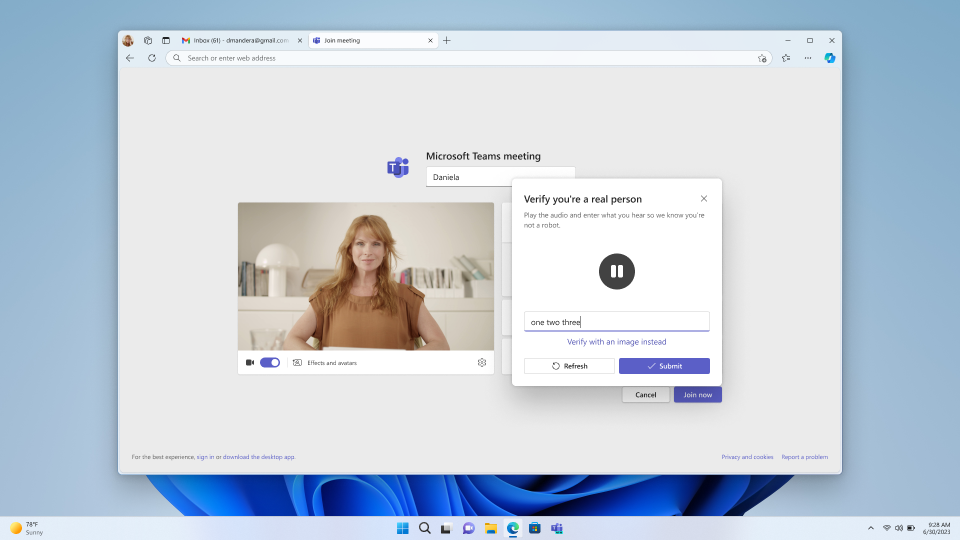
If this is a concern for your organization, we recommend starting with establishing a well-communicated HR policy prohibiting these tools use.  For example at Microsoft, while Microsoft 365 Copilot is of course secured, managed & available to Microsoft employees, 3rd party AI solutions are strictly prohibited by Microsoft Standards of Business Conduct,, particularly the use of ‘3rd party AI meeting notetakers’.  The reason this is such a high level concern is that there are many legal concerns with these tools including a lack of eDiscoverability, lack of Litigation Hold & potential deletion, lack of retention policies, lack of FedRAMP regulatory compliance (or CJIS or Tax1075 or…), etc.

The most common techniques to block these tools from use in Microsoft Teams are:

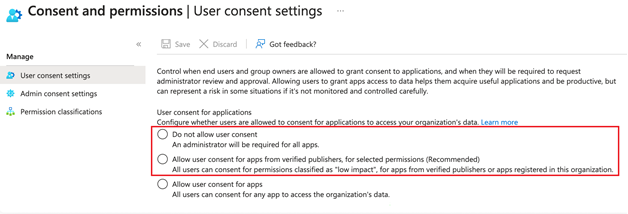
Also, if 3rd party Artificial Intelligence tools are able to present themselves as authorized attendees in your Microsoft 365 environment, they are unfortunately taking advantage of weakly IT-configured EntraID application authentication security.  Please review:

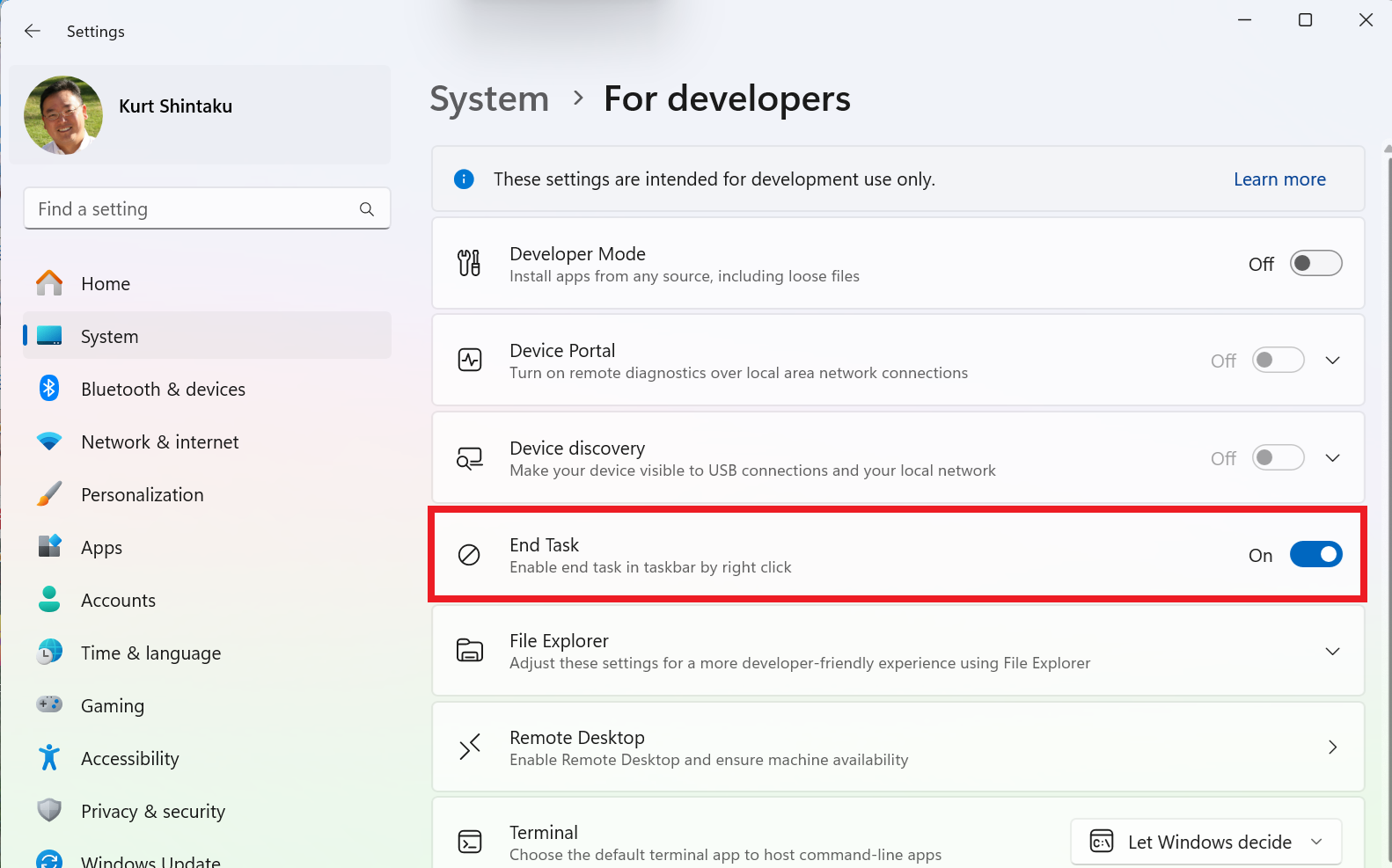
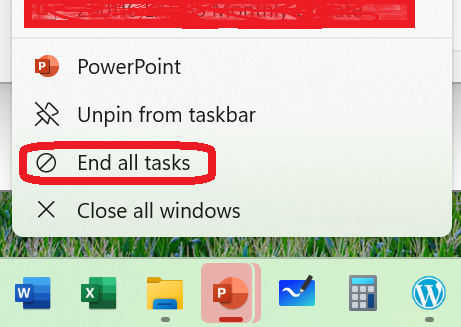
Want a quick shortcut to kill frozen applications directly from the Windows taskbar?

  1. Go to Windows Settings – System – For Developers
  2. Switch “End Task” to the ON position

The next time you right click an application in the Windows Taskbar, you should see a new menu option called “End all tasks”.

« Newer Posts - Older Posts »

Categories