 This was posted by Steven Sinofsky, about the newly announced file system to be included in “Windows Server 8”.
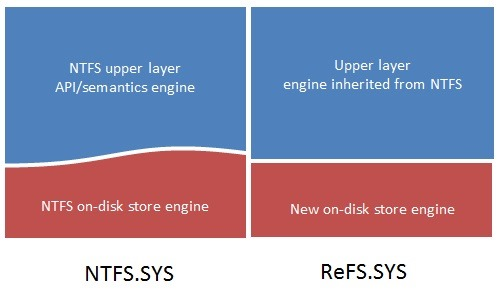
In this blog post I’d like to talk about a new file system for Windows. This file system, which we call ReFS, has been designed from the ground up to meet a broad set of customer requirements, both today’s and tomorrow’s, for all the different ways that Windows is deployed.
…
The key features of ReFS are as follows (note that some of these features are provided in conjunction with Storage Spaces).
- Metadata integrity with checksums
- Integrity streams providing optional user data integrity
- Allocate on write transactional model for robust disk updates (also known as copy on write)
- Large volume, file and directory sizes
- Storage pooling and virtualization makes file system creation and management easy
- Data striping for performance (bandwidth can be managed) and redundancy for fault tolerance
- Disk scrubbing for protection against latent disk errors
- Resiliency to corruptions with "salvage" for maximum volume availability in all cases
- Shared storage pools across machines for additional failure tolerance and load balancing
In addition, ReFS inherits the features and semantics from NTFS including BitLocker encryption, access-control lists for security, USN journal, change notifications, symbolic links, junction points, mount points, reparse points, volume snapshots, file IDs, and oplocks.
And of course, data stored on ReFS is accessible through the same file access APIs on clients that are used on any operating system that can access today’s NTFS volumes.
For more information:
http://blogs.msdn.com/b/b8/archive/2012/01/16/building-the-next-generation-file-system-for-windows-refs.aspx?prod=Win8&type=BL
 kurtsh
 Kurt Shintaku's Blog