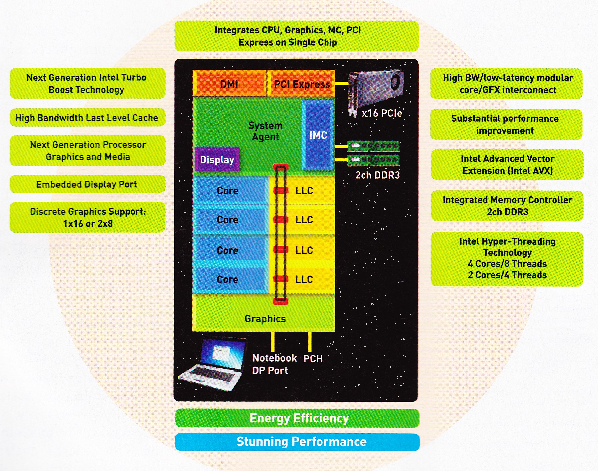
 Much has been made of Intel’s new Sandy Bridge architecture but a question that I got asked recently, “What is it? In 60 seconds or less?”
Put simply: “Sandy Bridge” is a new Intel processing microarchitecture. It’s very special in that it provides the following new capabilities or improvements:
- IMPROVED die shrink to 32nm
(Reduced trace size from 42nm in previous generation; die shrinkage reduces heat generation & power consumption) - IMPROVED bandwidth between compute cores (CPU)
(Previous multicore architectures were somewhat loosely coupled with marginal bandwidth between cores resulting in lesser performance) - IMPROVED graphics processing integration (GPU)
(Previous integrated GPUs were not in all processors and again, marginal bandwidth between graphics & compute cores diminished performance. Additionally, the graphics processor now shares cache with the compute cores making data sharing faster.) - NEW “Advanced Vector Extensions instruction set (AVX)” for CPU
(Increases efficiency of compute core usage by allowing operating system to issue specific condition sensitive instructions. Only available on Windows 7 Service Pack 1.) - NEW “Turbo Boost 2” Overclocking
(Previous chips overclocking effects would get marginalized when all cores were in use; Turbo Boost 2 now overclocks for performance consistently except when processor is detected to be overheating.) - NEW “SATA 6Gb/s” Storage Support
(Support for SATA 6GB/sec is now built into the microarchecture chipset enabling high performance throughput to SATA 6GB/sec capable storage devices – in particular, SSD drives)
There’s some other things but these are the big items. More can be read about Sandy Bridge below:
- More information:
http://www.intel.com/technology/architecture-silicon/2ndgen/index.htm
 kurtsh
 Kurt Shintaku's Blog